


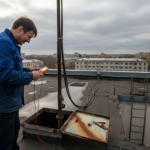
Installing a high-performance lightning protection system is never simply a matter of attaching a lightning rod to the roof. For every professional in France, compliance with standards such as IEC 62305 is a key issue for the safety of people and regulatory compliance. This article presents the essential components of a lightning protection installation, their precise role, and the right choices for reliable protection, according to current French and European market standards.
Table of Contents
- Definition and components of a lightning protection system
- Types of devices and operating principles
- Applicable French and international standards
- Legal obligations and responsibilities of the installer
- Risks, maintenance and mistakes to avoid
Key Points
| Point | Details |
|---|---|
| Complete Installation | A lightning protection system is an integrated system comprising several coordinated components. |
| Protection Levels | It is based on three levels: energy capture, conduction and dissipation. |
| Role of the Installer | The installer is responsible for the conformity and safety of the installation throughout its entire lifespan. |
| Regular Maintenance | Annual maintenance is essential to ensure the effectiveness of the lightning protection system. |
Definition and components of a lightning protection system
A lightning protection system is a complete and integrated system designed to safely capture, conduct, and dissipate the energy of atmospheric discharges. It protects structures, equipment, and people from electrical and thermal hazards related to direct or indirect lightning strikes.
This installation is not simply a lightning rod on the roof. It is a coordinated system where each element plays a precise role in the safety chain.
The three levels of protection
A complete lightning protection installation is based on three distinct levels:
- Capture : captures the discharge before it hits the structure
- Conduction : directs energy towards the earth without damage
- Dissipation : disperses energy safely into the ground
These three levels work together to reduce damage and the risk of fire or explosion.
Essential components of an installation
Here are the elements you will find in each protection system:
- Lightning capture system : conventional lightning rod, early streamer emission (ESE) lightning rod or Faraday cage lightning rods
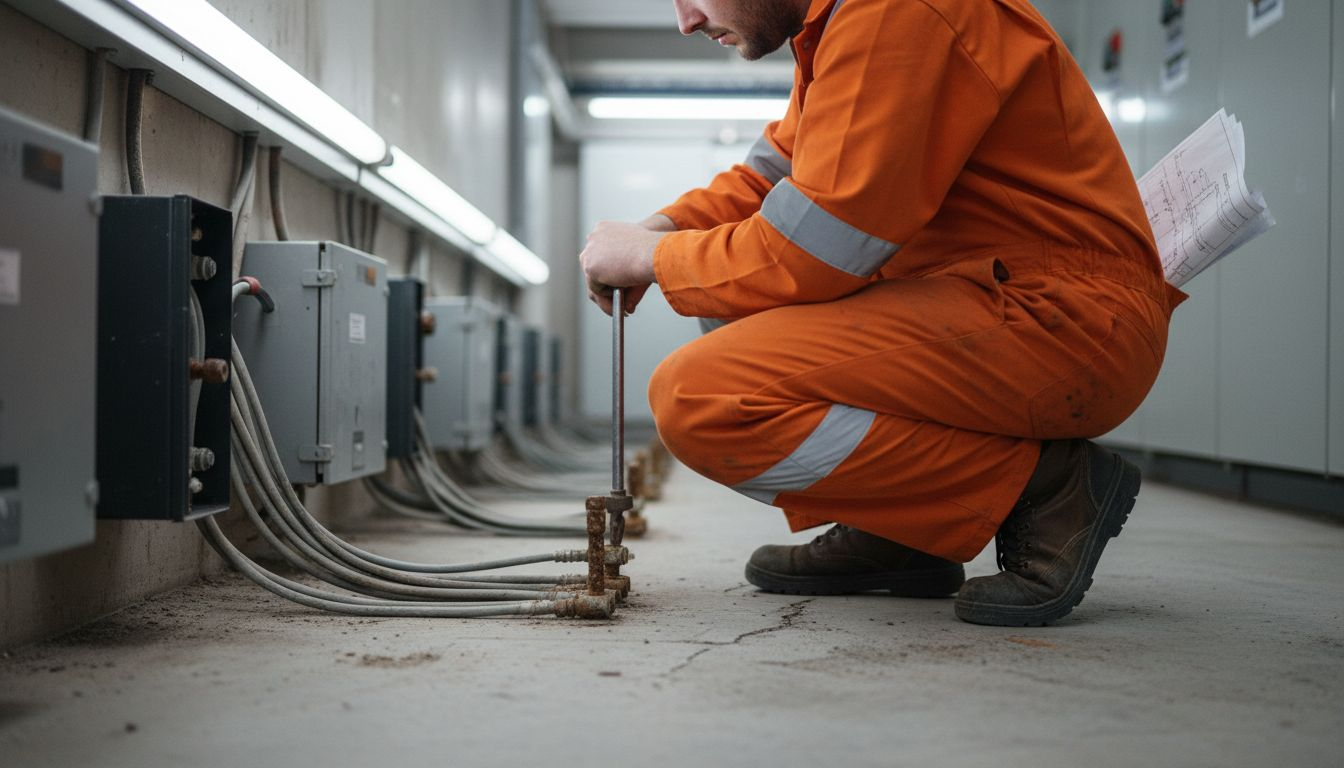
- Down conductors : metallic paths that carry the current to the ground
- Equipotential bonding : connects the metallic elements of the structure to prevent potential differences
- Surge protectors : protect electrical and electronic installations from power surges.
- Grounding : buried electrodes that dissipate energy into the ground
Each component must meet the technical standards for lightning protection in force in France and Europe.
Role of each element
The lightning rod : it's the first line of defense. It intentionally attracts lightning and channels it towards the ground in a controlled manner, preventing it from passing chaotically through the structure.
Down conductors : these form the path of least resistance for the lightning current. The lower the resistance, the better. Multiple parallel paths reduce the overall resistance.
Equipotential bonding : this connects all metallic conductive elements (pipes, sheaths, fittings) so that they remain at the same electrical potential. Without it, dangerous voltage differences can occur.
Surge protectors : these devices absorb or divert power surges that could damage sensitive electronic equipment. They complement external protection.
Grounding : this is the final step. Energy must be dispersed deep into the ground. Poor grounding compromises the entire system.
A lightning protection installation is effective only if all its components are correctly sized, connected and maintained according to current standards.
Differences between capture and internal protection
We must distinguish between two levels of protection: external and internal .
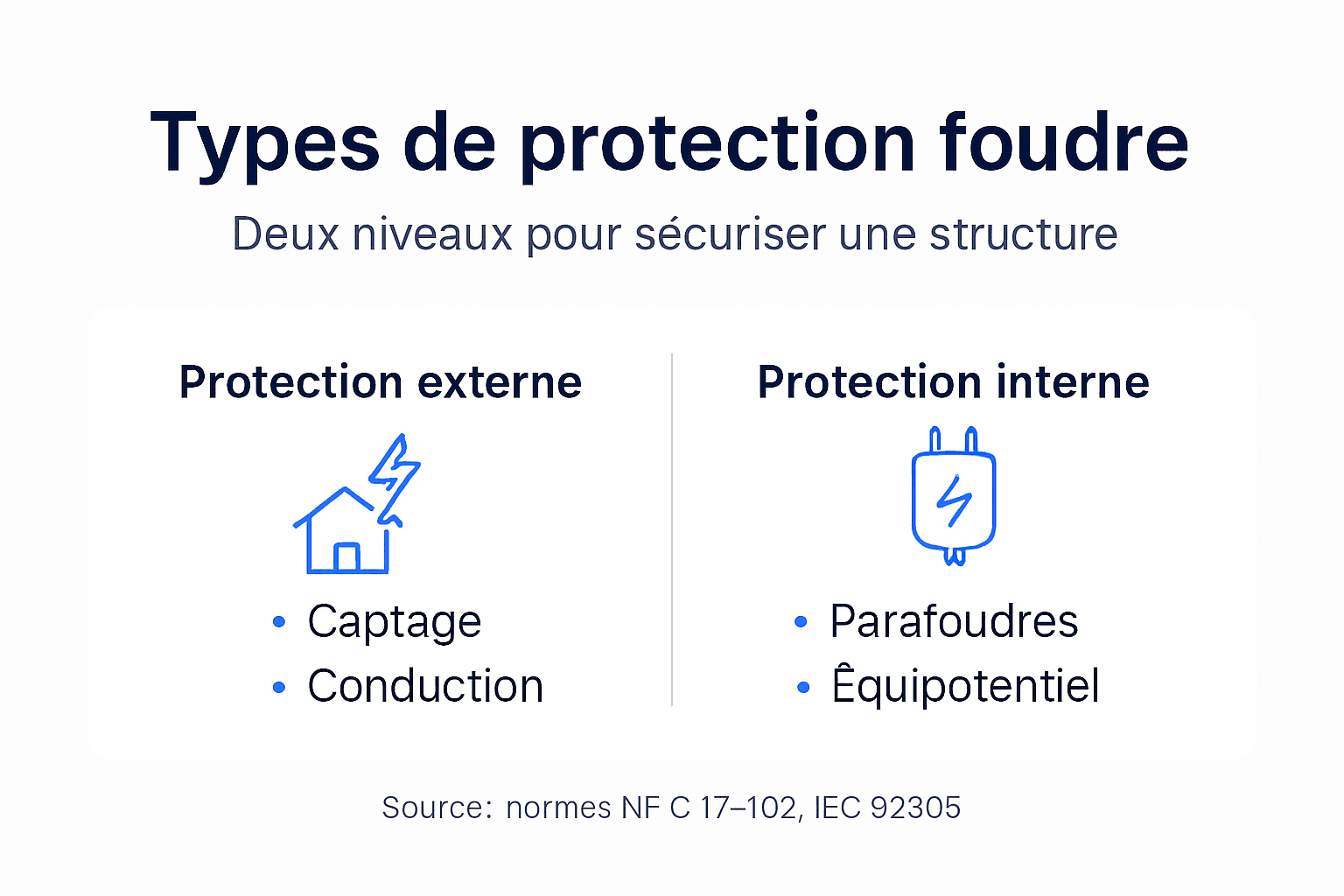
External protection (lightning rods) captures lightning from a distance. Internal protection (surge protectors) protects what's inside: electrical, electronic, and telecommunications equipment. Both are necessary for a robust system.
Pro tip: Always request a complete assessment of an existing installation before modifying it. Standards evolve, and an older system may require significant updates in terms of compliance and efficiency.
Types of devices and operating principles
Lightning protection relies on several categories of devices, each playing a specific role in the safety chain. Understanding how they work allows for a better assessment of an installation's needs and ensures appropriate protection.
Lightning rods: capture and conduction
The lightning rod is the primary lightning protection device . There are several types, each offering different performance levels depending on the context and structure.
Lightning rods are divided into three categories:
- Single-rod lightning rod : the classic model, consisting of a pointed metal rod at the top of the structure
- Early streamer emission (ESE) lightning rod : offers better protection by increasing the coverage area compared to a conventional rod
- Mesh lightning rod (Faraday cage) : encloses the structure in a conductive network that dissipates electrical energy around it
The operating principle of lightning rods is simple: they create a preferential path for lightning, attracting it before it strikes vulnerable structures. Once the current is captured, it is conducted to the ground via conductors.
Surge protectors: equipment protection
Surge protectors protect electrical installations against power surges by diverting excess energy to the ground. They act like "electrical sponges".
There are three types of surge protectors, depending on their function:
- Type 1 : Protection against direct overvoltages caused by lightning strikes
- Type 2 : Protection against switching and indirect overvoltages
- Type 3 : protection of sensitive devices at the end of the circuit
These devices must be correctly sized and installed as close as possible to the equipment to be protected in order to be effective.
Here is a comparative table of the main types of lightning protection devices:
| Device | Main role | Significant advantage | Main limit |
|---|---|---|---|
| Rod lightning rod | Primary intake | Simple installation | Limited protection zone |
| Early streamer emission lightning rod | Enhanced capture | Larger safety radius | Higher cost |
| Faraday cage | Global Dissipation | Full protection | Installation complexity |
| Lightning arrester | Internal defense | Backing up equipment | Does not block the direct impact |
Faraday cages and energy dissipation
The Faraday cage works differently. Instead of capturing a single point, it envelops the structure with a network of interwoven conductors. The energy dissipates around the cage rather than passing through it.
This system is particularly suitable for large buildings or structures containing highly sensitive equipment.
Surge protectors never replace an external lightning rod. They complement the protection by safeguarding what is inside against residual overvoltages.
Coordination between devices
The optimal operation of an installation requires that all devices work together in a coordinated manner. A power surge passing through an improperly sized surge protector can damage sensitive equipment.
Evaluating the protection radius of an initiation device helps to verify that all critical points are effectively protected.
Pro tip: Always verify that the protection levels of your surge protectors match the overall protection level of the installation. Inconsistent protection can create dangerous weak points.
Applicable French and international standards
Lightning protection in France and Europe is governed by a set of technical standards that define the design, installation, and maintenance standards. These standards guarantee a uniform and recognized level of safety.
Reference standards in France
France has a normative framework structured around two main standards: NF C 17-102 and NF C 61-740 .
NF C 17-102 is the French reference standard for the design and installation of lightning protection systems. It incorporates the principles of the international standard IEC 62305 and adapts them to the French context.
The NF C 61-740 standard governs the installation and maintenance of surge arresters in low voltage networks to ensure effective protection against overvoltages induced by lightning.
These two standards work together to cover the entire protection system.
The international standard IEC 62305
IEC 62305 standard is the international standard that is gradually becoming the standard in France and Europe. It defines four levels of protection (I to IV) according to the risk and the type of structure.
IEC 62305 is divided into several parts:
- Part 1 : General principles and risk assessment
- Part 2 : Risk Management and System Design
- Part 3 : Physical damage and human life
- Part 4 : Electrical and electronic installations
The choice between NF C 17-102 and IEC 62305 depends on the complexity of the project and the regulatory requirements specific to your site.
Regulatory obligations according to the type of structure
Certain installations are subject to legal obligations regarding lightning protection. Installations classified for environmental protection (ICPE) must carry out a Lightning Risk Analysis (ARF) and, if necessary, a Lightning Technical Study (ETF) .
The sectors concerned include:
- Petrochemicals and refining
- Storage of explosive or flammable products
- High-power electrical installations
- Telecommunications equipment
- Hospitals and critical data centers
Documentation and traceability
All installations must be documented and verified according to standards. Key documents include:
- ARF/ETF Design Study or Report
- Installation acceptance reports
- Certificates of conformity
- Annual audit reports
The traceability of these documents is essential to demonstrate compliance in the event of an audit or incident.
This table summarizes the documents required for regulatory traceability of an installation:
| Required document | Utility | Update frequency |
|---|---|---|
| Technical study (ARF/ETF) | Assess the risk level | With each modification |
| Certificates of conformity | Justify compliance with standards | With each reception or upgrade |
| Verification reports | Provide proof of the checks carried out | Annually |
| Maintenance report | Documenting the interventions | After each intervention |
French and international standards evolve regularly. An installation that complies today may require updating in the coming years.
Pro tip: Keep all your inspection reports and certificates of conformity up to date. They constitute your legal evidence in the event of a claim or regulatory audit.
Legal obligations and responsibilities of the installer
Lightning protection installers assume significant responsibilities that go beyond simply installing equipment. They must guarantee the safety of people and property while adhering to a strict legal and regulatory framework.
The central role of the installer
The installer is the central figure in any lightning protection project. Their role begins well before the work starts and continues long after commissioning.
The main responsibilities include:
- Technical planning and preliminary study
- Implementation in accordance with standards
- Conformity check before delivery
- Maintenance and periodic monitoring
- Complete documentation and traceability
Each item on this list has direct legal implications. Ignoring any of them exposes the installer to civil or criminal prosecution.
Compliance and documentation obligations
The installer must prepare a complete technical file , which will be submitted to the relevant authorities. This file must demonstrate that the installation complies with all applicable standards.
The technical file must include:
- Detailed installation plans
- Dimensioning calculations
- Equipment conformity certificates
- Evidence of grounding
- Test and verification reports
- Maintenance contracts
This documentation is not optional: it constitutes legal proof of compliance in the event of a claim or inspection.
Responsibility for the safety of people
A poorly designed or executed installation can endanger human life. The installer is legally responsible for any failures in their installation throughout its lifespan.
This means that if someone is injured or killed due to a faulty installation, the installer may be held civilly and criminally liable. Professional liability insurance plays a crucial role in this.
Mandatory maintenance and monitoring
The installation is not a finished product that can be forgotten after delivery. It must be checked regularly according to standards: generally once a year for standard installations.
The installer must:
- Plan these checks with the client
- Perform technical inspections regularly
- Document each intervention
- Report any identified defects
- Suggest corrections if necessary
Neglecting maintenance exposes you to even greater liability in the event of an incident.
Civil liability insurance
Every professional installer must have professional liability insurance appropriate to the sector. This insurance covers damage caused by a faulty installation.
Without this insurance, the damage would be the direct responsibility of the installer, which can be financially catastrophic.
The installer is responsible for the conformity and safety of their installation throughout its entire lifespan, not just at the time of commissioning.
Pro tip: Keep all technical documents, inspection reports, and certificates of conformity for at least ten years. This evidence legally protects you in the event of a dispute or claim.
Risks, maintenance and mistakes to avoid
A poorly maintained or poorly designed lightning protection system becomes a hazard rather than a safeguard. Understanding the dangers and common mistakes helps secure your structures and equipment.
The risks of improper installation
The consequences of a faulty installation are serious and multifaceted. Associated risks include significant material damage , electrical disturbances, and direct dangers to people.
An improperly sized or poorly executed installation can:
- Allowing lightning to pass directly into sensitive structures
- Creating hot spots through the Joule effect, causing fires
- Severely damage electronic equipment
- Endangering the lives of occupants by electrocution
- Causing explosions when storing flammable products
Every year, preventable disasters occur due to a lack of adequate maintenance.
The most common mistakes
Certain errors recur regularly and cause predictable failures. Identifying them allows us to prevent them.
Faulty grounding connections : this is the number one mistake. A poor ground connection renders the entire installation useless. The resistance must be less than 10 ohms according to the standards.
Non-functional surge protectors : installed without testing or replacing them promptly after an overload, they become empty shells incapable of providing protection.
Inadequate sizing : using a lightning rod that is too small or poorly positioned leaves unprotected areas exposed to direct impacts.
Lack of maintenance : the installation gradually deteriorates. Corrosion, loosening, equipment deterioration: without regular inspection, defects silently accumulate.
Maintenance: an ongoing obligation
Maintenance is not optional. It must be planned regularly according to current standards, typically once a year.
Effective maintenance includes:
- Complete visual inspection of the system
- Conductor continuity tests
- Earth resistance measurement
- Lightning arrester check
- Replacement of worn parts
- Documentation of all interventions
Maintaining lightning rods according to standards ensures that your installation remains effective year after year.
Specific risks by season
Some risks vary depending on the weather conditions. During thunderstorms, overloaded equipment can fail. In winter, freezing temperatures damage connections.
Increased vigilance before each critical season limits unpleasant surprises.
An unmaintained system loses 30 to 50% of its efficiency in less than five years. Maintenance is your best investment.
Pro tip: Schedule an annual inspection before the storm season and systematically document each intervention. This traceability protects you legally and alerts you to potential damage.
Ensure the compliance and safety of your lightning installations through integrated management
The complexity of French and European regulatory requirements, along with the need for rigorous maintenance, makes managing lightning protection systems particularly demanding. Faced with these challenges, the key lies in centralizing documentation, ensuring precise traceability of inspections, and monitoring weather events in real time to anticipate any risks. Whether you are an installer, inspector, or manager, consistency between studies, audits, and maintenance is essential to comply with NF C 17-102 and IEC 62305 standards while guaranteeing the safety of people and property.
Discover how LPS Manager is establishing itself as the all-in-one SaaS tool that supports you in creating and monitoring your lightning protection files with:
- Complete cycle management – “study, installation, verification and maintenance”
- Optimized access to regulatory standards and obligations
- Automatic monitoring of lightning events and real-time alerts
- Immediate, shareable reporting, guaranteeing proof of compliance
Leave no room for error in the security of your facilities. Switch now to professional, transparent, and efficient management with LPS Manager and fully control your legal and technical obligations.
Explore all the features to effectively protect your structures
Lightning protection installation: safety, standards and obligations
Frequently Asked Questions
What is a lightning protection system?
A lightning protection system is a system designed to capture, conduct and dissipate the energy of atmospheric discharges in order to protect structures, equipment and people from electrical and thermal hazards.
What are the main components of a lightning protection system?
The main components include a lightning arresting system, down conductors, equipotential bonding, surge arresters and grounding.
What is the importance of grounding in a lightning protection installation?
Grounding is essential because it allows the energy captured to be dispersed into the ground, thus protecting the installation from discharges and ensuring the proper functioning of the protection system.
What standards govern lightning protection installations?
The main standards in France are NF C 17-102 for the design of lightning protection systems and NF C 61-740 for the installation and maintenance of surge arresters.
Recommendation
- Lightning protection: Safety and compliance in France
- Lightning protection terminology: safety and compliance
- 6 Best Lightning Protection Practices for Installers
- How to conduct an effective lightning audit of your facilities
- Grundlegende Anforderungen and Normen für Elektroinstallationen in Wohngebäuden – IET-Berlin