


A surge protector is a bit like the airbag of an electrical installation. Most of the time, you don't need it. But when transient power surges occur, you're glad it's there.
However, the choice of surge protection remains a source of errors, especially when hesitating between Type 1, Type 2 and Type 3. We still see panels protected "on paper", but poorly coordinated, or wired with too long cables, therefore less effective.
This guide clarifies the role of each type, links it to common cases (residential, small commercial), then moves on to the sizing criteria and installation points that change everything.
Type 1, Type 2, Type 3: understanding who protects what (and where)
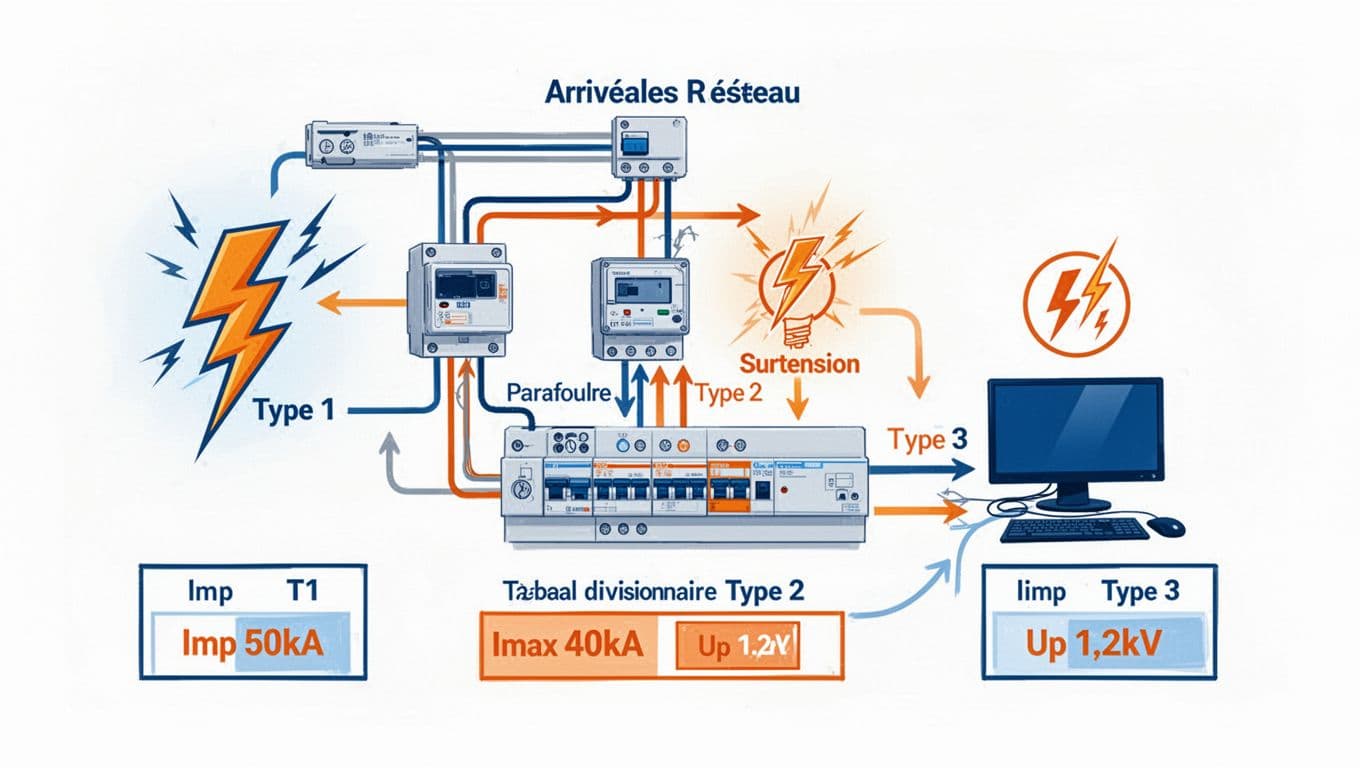
Low-voltage surge arresters are classified into types, according to testing and use (IEC 61643-11). In simple terms, a logic of successive "barriers" can be used, from the most robust to the thinnest.
- Type 1 : It absorbs some of the energy associated with a lightning strike, especially when the risk of a direct impact or incoming lightning current is real (for example, presence of a lightning protection system, overhead power line, exposed buildings). Tested with a 10/350 µs wave, its key parameter is the impulse current (Iimp) .
- Type 2 : This is the "panel-mounted" surge protector. It handles induced overvoltages, which are more frequent but less energetic. Tested with an 8/20 µs waveform, the main considerations are the nominal discharge current (In) and the maximum discharge current (Imax) , as well as the protection level (Up) .
- Type 3 : This is the finishing touch, closest to sensitive equipment. It's used when you want to further reduce residual overvoltage (computers, TVs, automation systems, set-top boxes, etc.). Its usefulness depends largely on the cable length and the sensitivity of the devices.
To clarify things, here's a quick reminder:
| Type of surge protector | Usual location | Parameter that we read first | Typical use |
|---|---|---|---|
| Type 1 | At the head of the installation | impulse current (Iimp) | Exposed sites, LPS, "hard" arrival |
| Type 2 | Main or sub-table | Nominal discharge current (In), maximum discharge current (Imax), protection level (Up) | Standard building protection |
| Type 3 | Near the devices | protection level (Up) | Thin protection of equipment |
For a structured explanation by types and test classes, you can refer to the manufacturers' "reference points" page, for example how to choose your surge protector (types 1, 2, 3) .
A good approach: first choose the location and the surge scenario, then select the type, not the other way around.
Starting from the actual risk and the requirements of NF C 15-100 (France, Belgium, Switzerland)
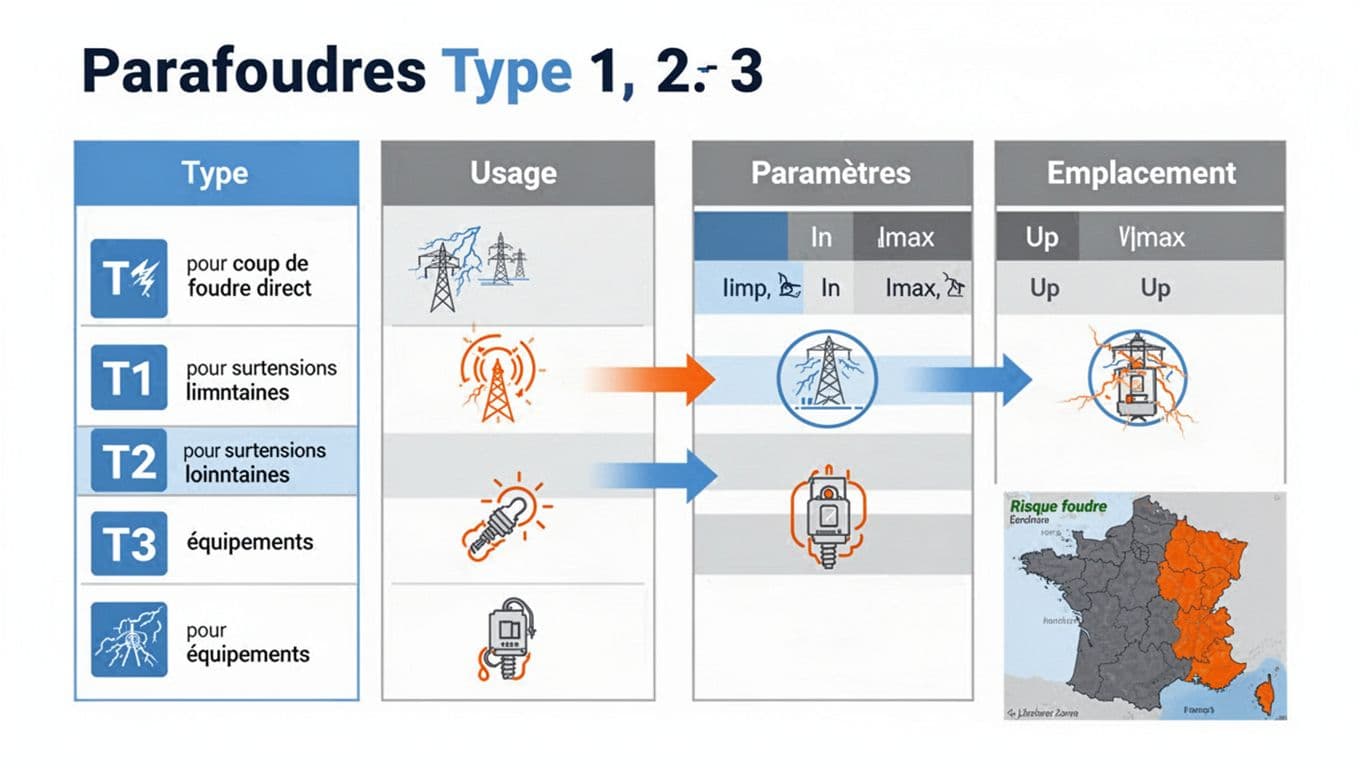
In real-world situations, lightning protection begins with a realistic risk assessment; you don't equip an isolated house the same way you equip a small office building full of electronics. Nor do you protect a site with a lightning rod the same way you protect a detached house in a low-storm area. Therefore, before choosing a specific model, you must assess the context based on the actual risk, particularly using the keraunic level, the lightning density, and, for France, the AQ2 zone.
Simple questions that quickly guide you to the right choice
We save time with three questions:
Does the site have a lightning rod, an external lightning protection system (LPS) or equivalent constraints? If so, a type 1 protection device at the head often becomes logical, or even mandatory in the presence of a lightning rod, because lightning current can "enter" through the networks.
Is the power supply network overhead, long, or located in an exposed area? The more the environment is conducive to power surges, the more essential a properly sized Type 2 surge protector becomes. In Switzerland, prevention information reminds us of the frequency of lightning strikes and their indirect effects; see data and measurements on lightning (PLANAT) .
Do we have sensitive or expensive equipment? A boiler, a ventilation system, a gate, a network cabinet, a home theater system—that changes things. In that case, a Type 3 outlet near the equipment makes sense, especially if the cable runs are long.
And in terms of standards, what are we really looking at?
In France, the NF C 15-100 standard governs electrical installation scenarios and the rules for implementing electrical installations. To remain aligned with the spirit of the NF C 15-100 standard, we rely on summary documents, such as the NF C 15-100 practical guide (PDF) , and on educational resources, such as when should a surge protector be installed ?
In Belgium and French-speaking Switzerland, the regulatory frameworks differ, but the method remains the same: identify the exposure, choose appropriate protection, and then ensure proper grounding. On our construction sites, it is often this last point that makes the difference between "installed" and "effective.".
Sizing and installation without sacrificing efficiency: Up, Uc, cabling, coordination
Once the type is chosen, the sizing of a surge arrester or protection device depends on a few values, easy to read on a technical data sheet, but easy to misinterpret.
The parameters to read (and how to relate them to the field)
- Maximum operating voltage (Uc) : this is adapted to the network (230 V single-phase, 400 V three-phase, TT system, TN system, etc.). An incorrect Uc value will cause the surge protector to age too quickly.
- Up (protection level) : the lower it is, the more the residual overvoltage is limited. This is a key figure when protecting electronics.
- Iimp (Type 1) , In/Imax (Type 2) : these are flow capacities, to be compared with the exposure scenario.
- Protection method : Depending on the earthing system and the distinction between common mode (between phase/neutral and earth) and differential mode (between phase and neutral), the wiring is not the same (LN, N PE, etc.). Connection details and design rules for low voltage are well summarized in the "Connecting Surge Arresters" guide (Schneider guide) .
The rule that is too often forgotten: the length of the connection
A surge protector can be excellent, but become mediocre if the wires act as "antennas." Every centimeter adds inductance, and therefore overvoltage. The grounding must be of good quality to effectively dissipate lightning current; otherwise, even a good, nearby ground connection is insufficient if the connections are long. Short, direct connections to the ground are recommended, along with a good quality ground connection; otherwise, the actual upstream voltage (Up) will increase.
In the field, simple guidelines are used, including the recommended connection distance (often less than 50 cm) and the wiring order at the electrical panel. For a clear reminder, see how to install a surge protector at the electrical panel .
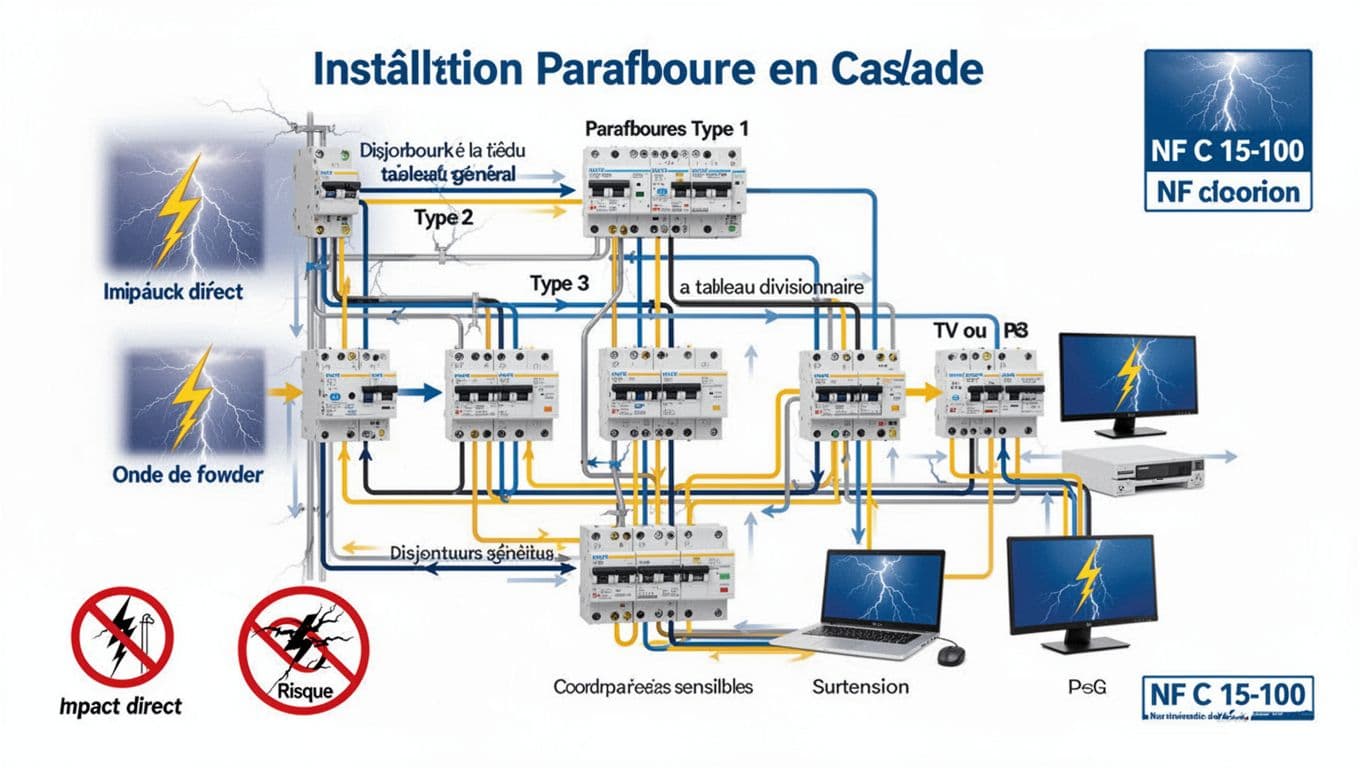
Our cascading coordination method (without overcomplicating things)
We avoid complicated setups, but we remain rigorous with this protective device:
- Type 2 surge protectors are placed at the main distribution board (this is the most common base).
- Type 1 surge arrester is added at the head if the site is exposed (LPS, arrival at risk).
- Type 3 surge protectors are added as close as possible to sensitive loads, especially if the circuits are long.
- We check the associated disconnection device (circuit breaker or fuse), according to the manufacturer's instructions.
- We are also thinking about copper networks (telecom, RJ45), because an overvoltage can enter through there, and this protection device must cover the whole thing.
To speed up the study and control process, we rely on the knowledge base, the wiki and the blog of lpsfr.com, then we centralize our choices and checks in LPS Manager (multi-site monitoring, scoring, audits, weather alerts).
Conclusion
A good surge protector isn't just "Type 1, 2, or 3." It's a protection system , tailored to the specific risk of the electrical installation, and installed with short connections and careful grounding. If you're unsure, start by assessing the site (exposure, network connection, sensitive equipment), then validate the Uc and Up parameters and discharge capacities to ensure the safety of this sensitive equipment. Lightning protection is a comprehensive strategy for the electrical installation. For further demonstrations and real-world examples, you can also follow the LPS YouTube .