
Many believe that installing a lightning rod is enough to protect a building from lightning. In reality, lightning protection is an integrated system combining lightning rods, surge protectors, and grounding, governed by strict standards such as IEC 62305 and NFC 17-102. This guide details the exact definition, essential components, applicable standards, mandatory risk analysis, professional responsibilities, and audit methods to guarantee compliance and safety in France.
Table of Contents
- Definition and key components of lightning protection
- IEC 62305 vs NFC 17-102 standards: a detailed comparison
- Lightning risk analysis compliant in France
- Legal obligations and responsibilities of professionals
- Audit methods and verification of protection systems
- Use of digital solutions for lightning protection management
- Summary and practical recommendations for professionals
- Discover our solutions to effectively protect your installations against lightning
Key points to remember
| Point | Details |
|---|---|
| Complete system | Lightning protection combines lightning rods, surge arresters and grounding according to IEC 62305 and NFC 17-102 to capture, guide and dissipate energy. |
| Four-panel IEC 62305 | This international standard covers the overall protection of people, structures, electronic installations and networks. |
| Mandatory analysis | The ARF is required for sensitive sites and guides the choice of the appropriate level of protection. |
| Annual maintenance | Periodic checks and rigorous traceability are required by French regulations. |
| Digital tools | SaaS platforms improve centralization, alerts, and compliance for all professionals. |
Definition and key components of lightning protection
Lightning protection refers to all the physical devices and technical measures designed to protect people, buildings, and equipment from the devastating effects of lightning. It is never limited to a simple lightning rod. A compliant system integrates three interdependent elements: roof-mounted lightning arresters, down conductors, and grounding.
Lightning rods capture the electrical discharge at altitude. Metallic conductors then guide this current to the ground. Finally, grounding dissipates the energy into the soil without causing damage. These three components form a complete circuit that must meet strict technical requirements to function effectively.
The NF EN IEC 62305 standards define the fundamental principles of this integrated protection. They impose design, sizing, and installation criteria for each element of the system. Without this comprehensive approach, even a properly installed lightning rod cannot guarantee any real safety.
The components must also comply with the NF EN IEC 62561 series, which certifies their reliability and performance. This compliance guarantees that each element withstands the electrical and mechanical stresses of atmospheric discharges.
Pro tip: Always check the certification of components before installation. A non-compliant component compromises the efficiency of the entire system and exposes you to professional liability.
Beyond external devices, comprehensive protection also includes internal surge protectors safeguarding electrical circuits and sensitive equipment. This multi-layered approach covers all possible points of lightning entry into a structure.
Lightning protection systems vary depending on the technology used: simple tip, Faraday cage, or early streamer emission (ESE) device. Each type addresses specific situations and requires a preliminary study to determine the appropriate solution for the building in question.
IEC 62305 vs NFC 17-102 standards: a detailed comparison
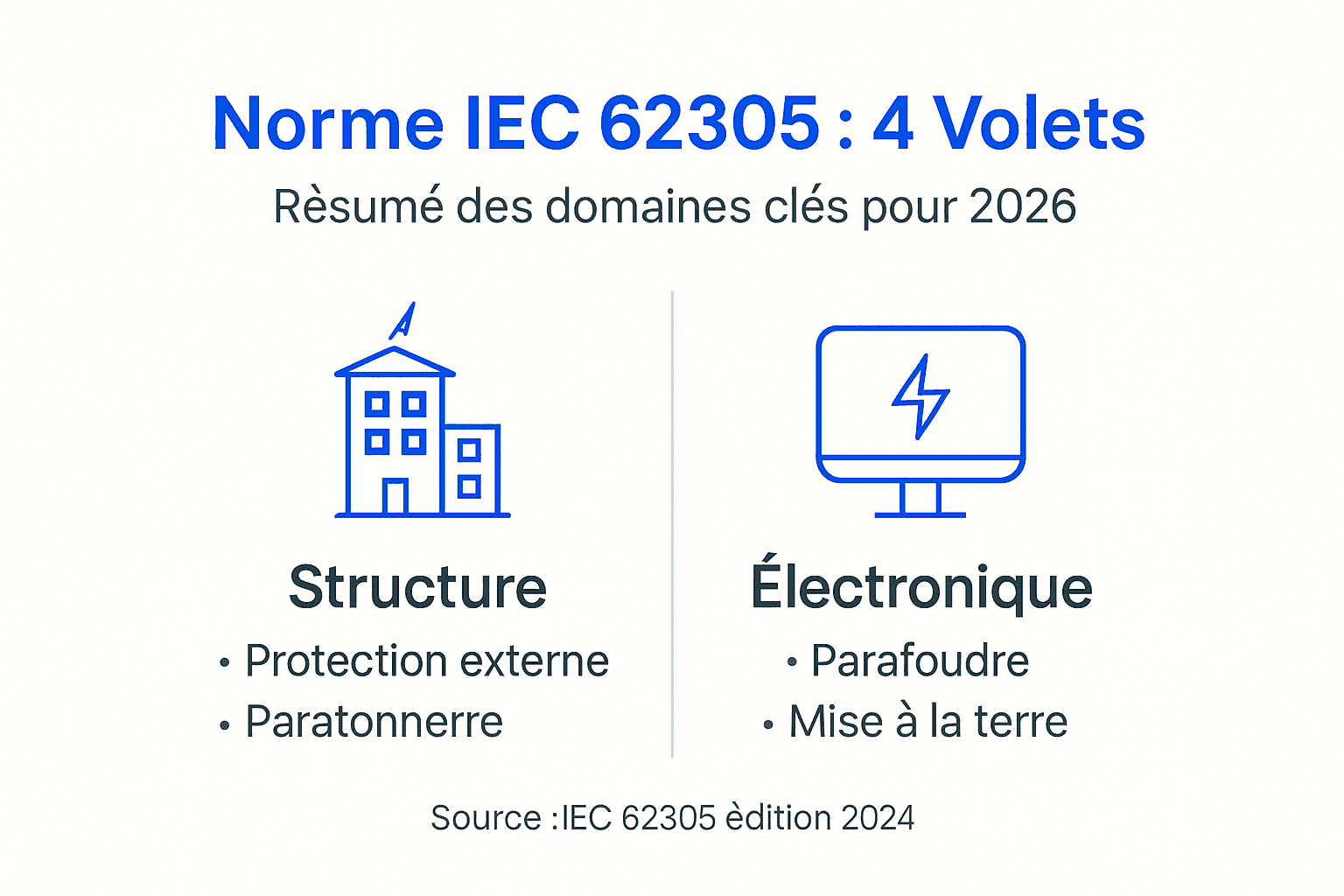
The international standard IEC 62305 is the global benchmark for lightning protection. Structured in four parts, it covers risk analysis, the protection of structures, electrical installations, and telecommunications networks. Its latest 2024 edition strengthens safety requirements and clarifies calculation methodologies.
The French standard NFC 17-102 focuses specifically on early streamer emission (ESE) lightning rods. It adds supplementary technical requirements adapted to the French regulatory context. These two standards are not contradictory but complementary, ensuring optimal protection in France.
| Criteria | IEC 62305 | NFC 17-102 |
|---|---|---|
| Scope | Global international protection | Specific PDA lightning rods France |
| Structure | 4 parts covering all aspects | Device-specific standard |
| Update | Recent 2024 edition | Regular national reviews |
| Application | Mandatory European framework | Mandatory PDA installations in France |
| Components | IEC series reference 62561 | Additional French requirements |
Professionals must apply both sets of standards simultaneously. IEC 62305 provides the general methodology for analysis and design. NFC 17-102 then imposes specific criteria for certain devices used in France.
The installed components must comply with the NF EN IEC 62561 series, which defines the technical requirements for each element of the protection system. This material conformity can be verified by certification and regulatory marking.
Pro tip: Keep all component conformity certificates in the technical file. These documents are required during regulatory inspections and prove your compliance with standards.
The main difference lies in the scope of application. IEC 62305 applies to all lightning protection installations, regardless of their technology. NFC 17-102 only covers PDA lightning rods that claim a protection radius greater than conventional devices.
Ignoring either standard exposes you to serious non-conformities. A system that complies with IEC but not NFC standards for its PDAs remains legally unacceptable in France. Inspectors and certification bodies systematically verify this dual compliance.
Lightning risk analysis compliant in France
Lightning Risk Analysis is the first mandatory step in any protection plan. It quantitatively assesses the probability and potential consequences of direct or indirect lightning strikes on a structure. This analysis follows a standardized methodology defined by IEC 62305-2:2024.
The structured analysis process comprises five essential steps:
- Identification of relevant risks according to the type of structure and its use
- Calculation of the probable frequency of direct and indirect impacts
- Assessment of potential losses: human, material, economic
- Comparison with the tolerable risk thresholds defined by the standard
- Determining the necessary level of protection and appropriate measures
The decree of October 4, 2010 mandates the ARF (Area of Risks and Firefighting) and the Lightning Technical Study for certain industrial sites classified as ICPE (Installations Classified for Environmental Protection). These documents then become mandatory components of the regulatory file submitted to the control authorities.
The assessment criteria include the frequency of local storms, the size of the structure, its immediate surroundings, and the vulnerability of its occupants. An isolated chemical plant in a storm zone presents a much greater risk than an urban warehouse in a less exposed area.
IEC 62305-2:2024 distinguishes four categories of risk: loss of human life, loss of public service, loss of cultural heritage, and economic loss. Each category requires a specific assessment with different tolerance thresholds.

Sector-specific examples: a data center requires maximum protection against electromagnetic interference. An agricultural silo primarily needs fire protection. A hospital must guarantee continuity of service. Each industrial context adapts the analysis to its specific risks.
The ARF then determines the required level of protection, rated from I to IV. Level I offers maximum protection for the most critical sites. Level IV is sufficient for low-risk structures. This level directly guides the technical design of the system.
Without a documented and compliant ARF (Automatic Fire Rating), no protection installation can claim regulatory compliance. Inspection bodies systematically require this document during initial and periodic inspections.
Legal obligations and responsibilities of professionals
Lightning protection professionals bear strict legal responsibilities governed by French regulations. These obligations cover the design, installation, verification, and maintenance of protection systems.
Three technical documents are mandatory for any installation:
- The As-Built Documentation, which precisely describes the completed installation
- The Lightning Technical Study details the calculations and justified technical choices
- Lightning Risk Analysis establishing the need and level of protection
These documents constitute proof of compliance required by the authorities. Their absence or incompleteness immediately renders the professional liable in the event of an incident or inspection.
The standards mandate periodic inspections at least annually. These inspections verify the physical condition of the components, earth resistance values, and the electrical continuity of the system. Inspection reports must be kept and made available.
The installers ensure the technical compliance of the implementation. The inspectors certify the condition and proper functioning after installation and during periodic checks. The site managers ensure monitoring and regular maintenance.
The legal risks of non-compliance are significant. An incident occurring on a defective or unverified installation exposes the operator to criminal prosecution for endangering others. Financial penalties include fines, damages, and withdrawal of certification.
The ten-year liability also applies to lightning protection systems. Any design or construction defect that compromises the system's strength or safety makes the professional liable for ten years after the work is completed.
Impeccable traceability is the best legal protection. Every intervention must be documented with photos, measurements, dates, and signatures. Detailed reports prove professional diligence in the event of a dispute.
The obligations also extend to safety and compliance in France, which imposes precise standards for each type of installation according to its regulatory classification.
Audit methods and verification of protection systems
Lightning protection audits follow a methodical process that ensures thorough checks. The recommended approach proceeds from top to bottom, successively inspecting lightning rods, conductors, surge arresters, and grounding.
Visual inspection is the first step. It detects physical damage: corrosion, loose fasteners, disconnected conductors, and mechanical damage. Geotagged photos document the observed condition and serve as evidence.
Electrical measurements are taken next. The earth resistance must comply with the maximum values defined by the standards. Electrical continuity between all components is checked with an ohmmeter. These numerical readings objectively demonstrate the actual state of the system.
The IEC 62793 standard specifically governs storm warning systems and associated measurement protocols. It defines the test procedures and acceptance criteria for this monitoring equipment.
| Audit Methodology | Traditional tools | Digital tools | Digital Advantages |
|---|---|---|---|
| Visual inspection | Paper checklist, camera | Mobile application with forms | Automatic tracking, geolocation |
| Measurements | Multimeter, notebook | Connected multimeter, direct input | Historical data, evolution curves |
| Documentation | Word report, workbook | Centralized cloud platform | Immediate access, secure sharing |
| Periodic monitoring | Scattered Excel files | Summary Dashboard | Automatic alerts, indicators |
Comprehensive documentation is essential. Each inspection generates a detailed report including photos, annotated diagrams, measurements, and conclusions. This visual and technical evidence constitutes the compliance file.
Digital monitoring is revolutionizing audit management. SaaS platforms centralize all reports, generate alerts before verification deadlines, and enable secure sharing with all authorized stakeholders.
Pro tip: systematically photograph each checkpoint. A geotagged and time-stamped image is better than a long text description to prove the observed condition.
The benefits of digital monitoring go beyond simple traceability. Comparative histories detect progressive degradation. Summary dashboards facilitate preventive maintenance decisions.
To conduct an effective lightning audit , methodological rigor takes precedence over speed of execution. A sloppy audit offers no value and exposes the auditer to significant legal liabilities.
Use of digital solutions for lightning protection management
Digital tools are radically transforming the operational management of lightning protection. They address the concrete challenges faced by professionals: scattered documentation, difficult coordination between stakeholders, and the risk of overlooking regulatory deadlines.
The centralization of field data is the primary benefit. Inspection photos, audit reports, plans, certificates of conformity, and maintenance histories are all found in a single interface accessible from mobile or desktop.
Automated weather alerts anticipate risks. Geolocation of facilities triggers monitoring of local storm conditions. Push notifications warn managers before each critical event.
Multi-user management facilitates collaboration. Installers, auditors, and managers share files with granular access rights. Exchanges are logged, and decisions are documented in the file's discussion thread.
The time savings become substantial. Automatic report generation from collected data eliminates re-entry. Instant sharing via PDF or web URL speeds up approvals and reduces administrative delays.
Regulatory compliance is automatically reinforced. Automated reminders before verification deadlines prevent oversights. Report templates include all mandatory sections. Historical data demonstrates continuous monitoring.
- Document centralization with instant search
- Automatic alerts based on geolocation and weather forecasts
- Reports generated and immediately shareable
- Summary dashboards by site or park
- Easy integration with maintenance management systems
Pro tip: prioritize solutions offering a free version to test the ergonomics and essential functions before investing in a full professional subscription.
Optimizing lightning protection necessarily involves digital tools. Multi-installation industrial sites can no longer manage the complexity of documentation and regulations manually.
Historical weather data and lightning protection systems allow for retrospective analysis of events and anticipation of maintenance needs. This predictive approach reduces emergency response costs.
The role of the lightning protection system inspector is evolving towards more advisory and analytical support thanks to consolidated data. Digital tools free up administrative time, allowing them to focus on technical expertise.
Summary and practical recommendations for professionals
Lightning protection requires a rigorous, systemic approach. A single, isolated lightning rod is never sufficient. Only the complete integration of lightning arresters, conductors, and grounding systems guarantees true safety.
Strict adherence to IEC 62305 and NFC 17-102 standards remains mandatory. These standards precisely define calculation methodologies, sizing criteria, and implementation requirements. No deviations are permitted.
A lightning risk analysis forms the basis of any compliant protection system. It must be documented, dated, and signed by a qualified professional. This document guides all subsequent technical decisions and binds the signatory to its responsibility.
Regular maintenance and annual audits are not optional. They are legal obligations, and failure to comply can result in criminal and civil penalties. Complete traceability of these interventions provides legal protection for all parties involved.
Digital solutions are no longer a mere gadget but an operational necessity. They are the only way to effectively manage complex documentation, multiple deadlines, and coordination between stakeholders.
- Document each intervention thoroughly with photos and measurements
- Keep all certificates of conformity for the installed components
- Schedule annual checkups with automatic reminders
- Centralize documentation in an accessible and backed-up system
- Continuously train yourself on regulatory and technical developments
Professionals must anticipate regulatory changes. The 2024 edition of IEC 62305 introduces stricter requirements that will gradually impact French practices. Staying up-to-date with regulatory developments is becoming essential for competitiveness.
Discover our solutions to effectively protect your installations against lightning
You have just learned about the technical and regulatory requirements for lightning protection. LPS Manager provides practical support for their daily implementation with tools designed for industry professionals.
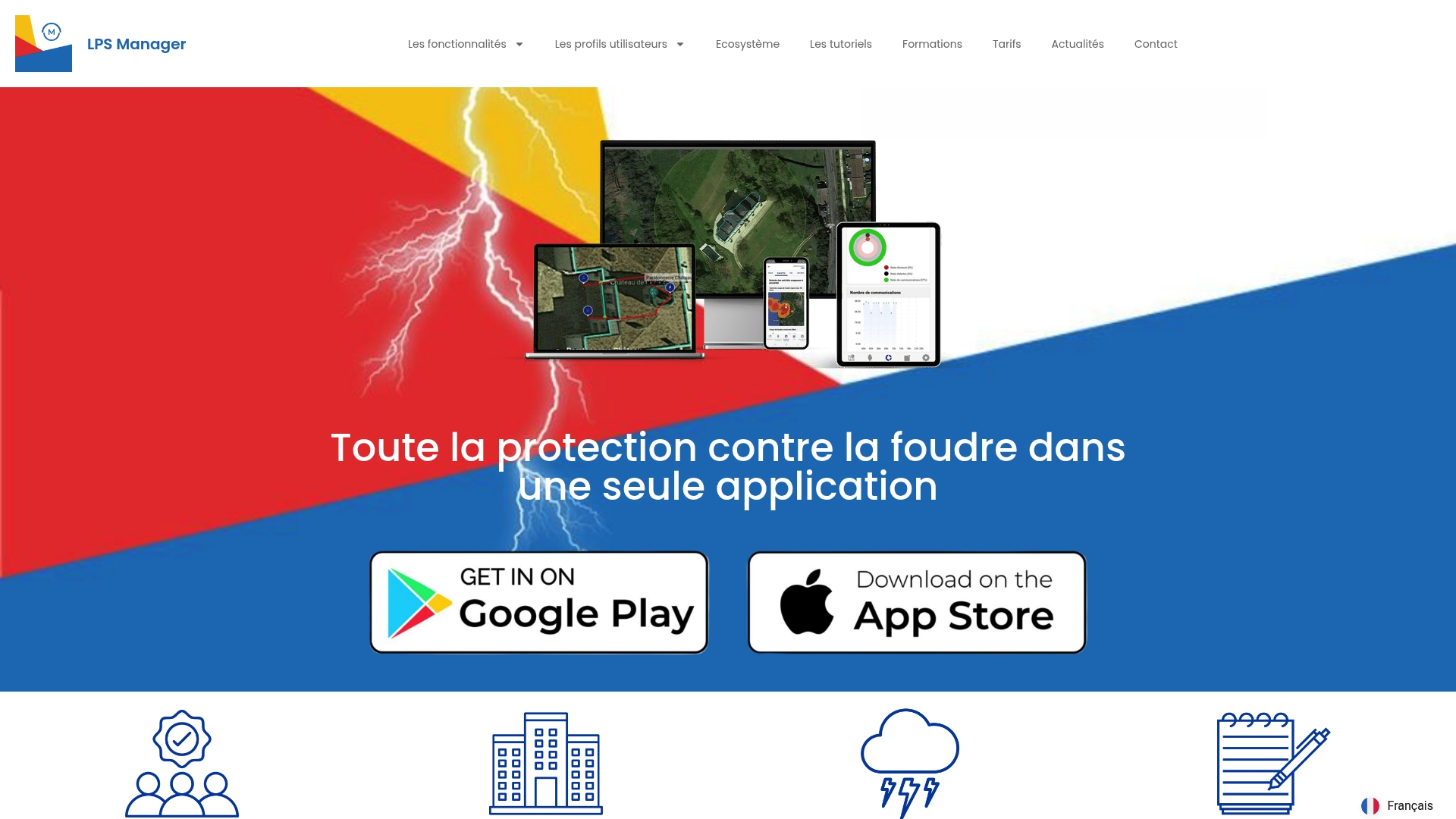
Our platform centralizes the complete management of your facilities: creation of site-specific files, execution of compliant studies, structured audits, and automatic generation of shareable reports. Safety and compliance in France are finally accessible without administrative friction.
Plan and track your inspections and audits with automatic reminders and standards-compliant templates. Manage all 7 types of lightning protection in a single interface accessible on mobile and desktop. Geolocation-based weather alerts help you anticipate risks at your sites.
Thousands of professionals trust LPS Manager for their daily compliance needs. Discover our solutions tailored to your business, from independent professionals to multi-site companies.
Frequently asked questions about the definition and protection against lightning
Why is the NFC 17-102 standard complementary to IEC 62305?
NFC 17-102 imposes specific requirements for early streamer emission (ESE) lightning rods used in France. It supplements IEC 62305 by adding technical constraints adapted to the French regulatory context, particularly regarding certification and claimed protection radii.
What are the risks in case of failure to maintain lightning protection?
A poorly maintained system gradually loses its effectiveness. Corrosion increases electrical resistance, loose fasteners create discontinuities, and degraded components can fail upon impact. Risks include fire, serious property damage, and endangering people. Legally, the operator is liable to criminal prosecution for negligence.
How to choose between different types of lightning rods for an industrial site?
The choice is based on a mandatory risk analysis that determines the required level of protection. This analysis considers the building's dimensions, its surroundings, its vulnerability, and the activity carried out within it. Lightning rods must comply with NFC 17-102. A qualified engineering firm guides this technical selection based on the specific context.
What documents must be kept after installation?
The As-Built Documentation describes the completed installation with plans and photographs. The Lightning Protection Technical Study justifies the technical choices through standardized calculations. The Lightning Risk Analysis establishes the necessity of protection. All periodic inspection reports and component conformity certificates complete this mandatory documentation.
What are the benefits of a connected storm alert system?
Geolocation-based alerts anticipate storm events in the immediate vicinity of your facilities. This anticipation allows for preventative interventions: securing sensitive equipment, temporarily shutting down critical processes, and mobilizing maintenance teams. Time-stamped alert tracking also improves document management and facilitates correlation with potential incidents.