



Every industrial site manager knows that a thunderstorm in France can transform an ordinary day into a major challenge for the safety of people and equipment. Managing the meteorological impact of lightning is not just about preventing power outages; it's about protecting production, the environment, and the company's liability. The decree of October 4, 2010, mandates a lightning risk analysis compliant with the NF EN 62305-2 standard, followed by the installation and regular verification of protection systems . Understanding how to structure these processes helps minimize interruptions and economic losses.
Table of Contents
- Definition and challenges of meteorological impact
- Regulatory and normative challenges
- Operational and economic challenges
- Environmental and health issues
- Weather risks and types of damage
- Standards and obligations for lightning management
- Digital tools for monitoring and compliance
- Use cases and benefits for managers
Key Points
| Point | Details |
|---|---|
| Meteorological Impact | Lightning represents a major risk that can cause material damage, injuries, and production interruptions. |
| Regulatory Obligations | The law requires risk analyses and technical studies to ensure the compliance of your facilities. |
| Economic Consequences | Production stoppages due to lightning strikes result in significant financial losses for the company. |
| Active Prevention | Proactive management and regular checks help reduce risks and ensure operational continuity. |
Definition and challenges of meteorological impact
The meteorological impact in industrial lightning management refers to all the risks and damage caused by climatic phenomena, particularly lightning, on the installations and equipment of a factory or sensitive site.
This is not simply a matter of electricity. The consequences directly affect the safety of your employees, your production, and your environment.
Concrete risks in an industrial setting
Lightning strikes at industrial sites cause widespread material and human damage:
- Electrical surges : damage sensitive circuits and automated systems
- Fires and explosions : increased risk in explosive atmosphere environments
- Burns and electrocutions : serious or fatal injuries to staff
- Destruction of equipment : electrical appliances, security systems, structures
- Production interruptions : unexpected shutdowns and major economic losses
Beyond immediate damage, lightning strikes create secondary consequences. Evacuation of personnel, loss of electrical power, and disruption of critical processes cascade through operations.
The impact goes beyond mere material destruction: it is a threat to business continuity and the legal liability of the manager.
Regulatory and normative challenges
In France, the law imposes specific obligations on you. Classified installations must comply with a strict regulatory framework.
This obligation is based on:
- Lightning Risk Analysis (LRA) based on standard NF EN 62305-2
- Lightning Technical Study (ETF) defining the appropriate protection measures
- Installation and regular verification of prescribed protective equipment
- Compliance documentation to be kept and updated
Understanding meteorological phenomena related to lightning is essential to properly sizing your protection.
Non-compliance exposes your company to administrative sanctions, criminal prosecution in the event of an accident, and civil liability.
Operational and economic challenges
Proactively managing the impact of weather reduces the risk of production downtime. Every day of downtime is costly.
Failures of unprotected equipment cause:
- Direct production losses (workshop shutdowns, production line stoppages)
- Costs of repairing and replacing damaged equipment
- Legal obligations to comply with standards (additional investments)
- Insurance premiums will increase if claims are repeated
- Reputational risks and disruption to key clients
Properly sized and regularly checked protection limits these impacts.
Environmental and health issues
The impacts of weather are not confined to the site. The damage causes pollution and harmful effluents.
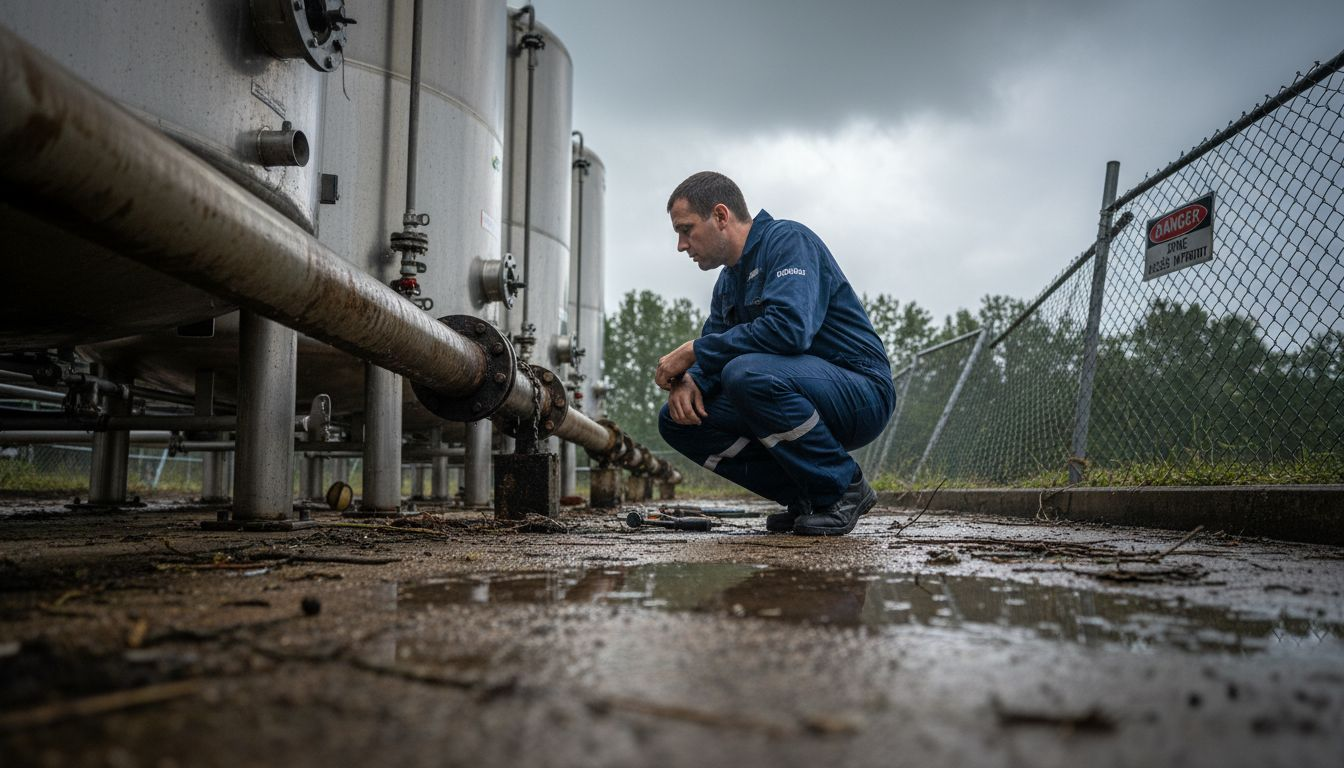
An explosion or fire caused by a lightning strike releases air pollutants. Poorly protected facilities can release toxic substances into the environment or groundwater.
Your environmental responsibility is engaged, beyond just the direct impacts.
Pro tip: Structure your checks around the weather calendar: before and after each storm season, audit the condition of your protection system. Damage caused by repeated impacts accumulates silently.
Here is a summary of the issues related to industrial lightning:
| Stake | Potential consequence | Economic impact | Environmental impact |
|---|---|---|---|
| Security | Staff injuries | Costly production shutdowns | Pollution during an accident |
| Production | Equipment failures | Loss of revenue | Process interruption |
| Regulatory | Legal non-compliance | Fines and prosecutions | Responsibility engaged |
| Sanitary facilities | Burns, electrocutions | Increased assurance | Toxic contamination |
Weather risks and types of damage
Lightning is never predictable, but its effects on your industrial site are. Understanding the types of weather hazards and the damage they cause is essential to protecting your equipment and employees.
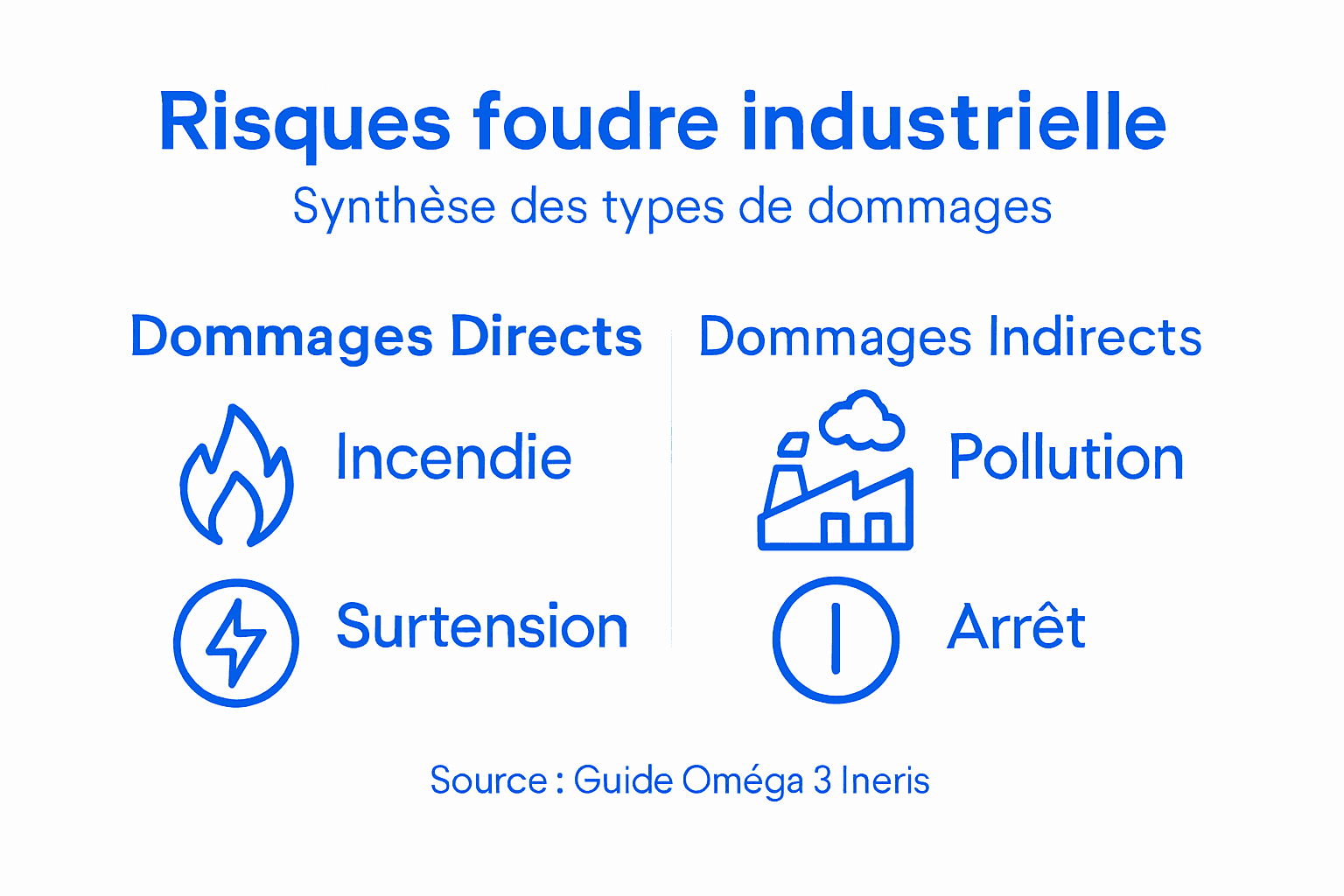
Direct and indirect damages
When lightning strikes, it creates two distinct categories of damage. Direct damage is visible immediately; indirect damage sometimes manifests later and poses serious operational challenges.
Direct damages :
- Lightning strikes on roofs, walls, and metal structures
- Destruction of tanks, transformers, exposed equipment
- Fires caused by overheating or electric arcing
- Explosions in areas with explosive atmospheres
Indirect damages :
- Power surges : damage sensitive electrical circuits and automated systems
- Short circuits : cause cascading malfunctions
- Process interruptions : unexpected production shutdowns
- Power outage : general system failure
French industrial accident statistics record approximately 200 lightning-related events each year in classified facilities.
An indirect impact can be more costly than a direct impact: the interruption of production quickly exceeds the cost of the damaged equipment.
Human and environmental risks
Lightning poses a direct threat to your employees and the surrounding environment. Burns, electrocutions, and emergency evacuations are immediate consequences.
But the danger extends beyond that:
- Air pollution during fires
- Hazardous discharges of chemicals or toxic products
- Groundwater contamination
- Long-term environmental damage
You are legally responsible for these impacts. Environmental damage caused by lightning can lead to prosecution and substantial fines.
Cascading failures
Modern systems are interconnected. A lightning strike on a piece of equipment often triggers a chain of failures that is difficult to control.
The power surge propagates via:
- Electrical networks (main power supply, control circuits)
- Communication cables (data, telecoms, industrial networks)
- Equipotential bonding (insufficiently protected)
This cascade of events makes downtime prolonged and costly. A single impact can paralyze several workshops.
Economic impact and continuity
Every hour of downtime results in direct and indirect financial losses. Customers receive their orders late, contracts are jeopardized, and reputation suffers.
Damage caused by lightning also includes increased insurance premiums, emergency repair costs, and legal obligations to bring buildings up to code.
Properly sized protection limits these impacts and secures your operational continuity.
Pro tip: Document all lightning incidents (even minor ones) and their associated costs. This historical data justifies protection investments and guides your sizing decisions.
Standards and obligations for lightning management
In France, lightning protection management is mandatory for classified installations. The law imposes a strict framework and specific steps that you must follow to ensure the safety of your employees and your facilities.
The French regulatory framework
The decree of October 4, 2010, sets out the provisions relating to lightning protection for classified installations subject to authorization. This decree applies to specific categories and imposes a precise implementation schedule.
You need to know your exact situation: is your installation subject to these obligations? The relevant section of your website determines your mandatory compliance.
Failure to comply exposes your business to administrative and criminal prosecution. Inspections may reveal serious deficiencies and lead to temporary or permanent closures.
The three mandatory steps
The law mandates a structured three-phase approach. Each phase must be documented and kept available for inspection by the authorities.
Step 1: Lightning Risk Analysis (LRA)
A lightning risk analysis based on the NF EN 62305-2 standard is mandatory. This analysis assesses your exposure, your vulnerable equipment, and the potential damage.
The ARF determines whether your site requires additional protection or is already compliant.
Step 2: Lightning Technical Study (LTS)
If the ARF concludes that protection is necessary, you must carry out a lightning protection study . This study prescribes the appropriate protection measures: type of lightning rod, sizing of surge arresters, grounding, etc.
Step 3: Installation and Verification
Protective equipment must be installed in accordance with the ETF and then checked regularly. Annual or biennial checks ensure the system's effectiveness.
Each step generates documents that you must archive. The inspector may request them at any time during an inspection.
Applicable norms and technical standards
Lightning protection is based on the NF EN 62305 standard , which covers risk analysis, system sizing, and verification. This standard is the reference in France and Europe.
Variations exist depending on your type of installation:
- Simple structures: simplified method (FD C 17-108)
- Complex or sensitive structures: complete method NF EN 62305-2
- Special installations: supplementary sectoral standards
The choice of method depends on your situation. A consulting firm can guide you if you exceed the simplified criteria.
Maintenance and periodic checks
Lightning protection does not end with the initial installation. Maintenance of lightning rods according to current standards is mandatory.
Required checks:
- Annual visual inspection of general condition
- Continuity checks of drivers every 2 years
- Annual measurement of grounding resistance
- Replacement of worn or damaged parts
These checks must be recorded in a tracking file accessible to the inspector.
Pro tip: Create an annual maintenance schedule and assign responsibility to a single point of contact. Keep all inspection reports in a centralized folder: authorities appreciate this organization during audits.
Digital tools for monitoring and compliance
Modern digital tools are transforming lightning protection management. Instead of managing scattered paper documents, you can centralize, automate, and monitor in real time. This saves you time and reduces the risk of oversights or non-compliance.
Artificial intelligence and risk analysis
Advanced digital tools incorporate artificial intelligence to automate lightning risk assessment. These platforms combine historical storm data, structural characteristics, and existing protection levels.
The result? Detailed reports with personalized recommendations, generated in hours instead of weeks.
AI also identifies weaknesses you might have overlooked. It cross-references your local data with international patterns to anticipate vulnerabilities.
Centralization and document traceability
Paper-based management exposes your company to significant risks. Documents get lost, files go astray, and during an inspection, you can't find anything.
A centralized digital tool:
- Lightning Risk Analyses (LRA) and Lightning Technical Studies (LTS)
- Annual or biennial audit reports
- Maintenance and intervention history
- Photos and diagrams of your installations
- Certificates of conformity and product warranties
Everything is accessible with a single click, sorted by site and date. When the inspector arrives, you present a flawless file.
A well-structured digital tool transforms the inspection of a source of stress into a demonstration of rigor.
Real-time weather monitoring
Weather monitoring is no longer limited to expensive weather stations. Modern digital tools geolocate your site and automatically receive alerts for storms, high winds, or abnormal conditions.
Immediate benefits:
- Push or email alerts in case of an approaching storm
- History of weather events and detected impacts
- Correlation between alerts and the status of your equipment
- Automatic triggering of checks after a critical event
These alerts allow you to act quickly before damage accumulates.
Collaborative management and communication
During an inspection, several stakeholders must collaborate: the site manager, field technicians, the engineering firm, and sometimes the insurance company. A unified tool facilitates this coordination.
Collaborative features:
- Creating shared folders by site or by project
- Annotate and add photos directly on site via mobile
- Secure messaging between participants
- Generation of pre-formatted reports, ready to send
- Managing access rights by role and by site
An effective lightning audit relies on clear coordination between all participants. A digital tool makes this coordination transparent and rapid.
Scoring and decision support
Some tools calculate a compliance or urgency score based on your installation settings, event history, and equipment status. This score (e.g., 0 to 100%) allows you to prioritize your actions.
A low score signals: urgent verification, priority maintenance, or equipment replacement.
This decision-making aid avoids administrative paralysis and allows you to focus on what really matters.
Pro tip: Deploy the tool initially on a single pilot site. After 3 months, measure the time savings and the quality of compliance: this justifies full deployment and convinces your teams to adopt it.
Here is a comparative overview of numerical methods for lightning management:
| Digital tool | Main function | Key advantage | Profit for the company |
|---|---|---|---|
| AI Analysis | Automated risk assessment | Custom reports | Speed of identification |
| Document centralization | File storage and organization | Easy traceability | Reduction in forgetfulness |
| Real-time weather alerts | Immediate thunderstorm notification | Proactive anticipation | Reduce incidents and stoppages |
| Digital collaboration | Sharing and communicating information | transparent coordination | Audit/maintenance efficiency |
Use cases and benefits for managers
The manager of an industrial site faces a simple reality: lightning can strike at any time. Effective risk management transforms this threat into an operational advantage. Here's how real-world managers leverage a structured approach.
Anticipating damage and reducing losses
Effective lightning risk management allows for the anticipation of damage and the minimization of production interruptions. Analysis of past experience shows that preventive measures compliant with standards significantly reduce incidents.
Anticipating means acting before disaster strikes. A manager who controls their lightning risks sleeps better at night.
Well-maintained records also allow insurers to recognize your diligence. This can translate into lower premiums or better coverage in the event of a claim.
Operational continuity and reduced downtime
Every production stoppage is costly. A poorly managed lightning strike can paralyze an entire production line for days. Properly sized and regularly inspected protection dramatically reduces these risks.
Concrete benefits:
- Fewer unexpected shutdowns of critical equipment
- Meeting delivery deadlines for customers
- Preservation of long-term contracts
- Reduction of emergency maintenance costs
A manager who maintains continuity becomes a strategic asset for their company.
Business continuity is not an expense, it is an investment protecting your revenue.
Personal safety and responsibility
Your legal responsibility extends to occupational risks. A lightning strike causing burns or electrocution exposes your company to criminal prosecution.
Appropriate protection demonstrates your diligence:
- Risk analysis regularly updated
- Compliant and verified installations
- Staff risk training
- Complete documentation of each action
The Omega 3 guide from Ineris helps managers identify appropriate protection needs and prioritize investments. This scientific reference ensures the security of your decisions.
Optimizing systems and reducing costs
Too often, companies overprotect: oversized lightning rods, unnecessary surge protectors, excessive checks. Good management identifies the right balance.
Optimizing means:
- Install what's needed, no more, no less
- Prioritize protective measures according to the actual risk
- Avoid unnecessary investments
- Maximize return on investment
This reduces your operating expenses while maintaining robust protection.
Easier compliance and administrative peace of mind
Managers spend hours on administrative tasks: searching for documents, writing reports, preparing for audits. A digital tool combined with structured management frees up these hours.
The result? More time for strategy, less for administration. And during inspections, an impeccable file.
Pro tip: Identify the three major lightning hazards at your site (critical equipment, sensitive area, concentration of personnel) and focus your efforts on those areas. This improves safety and reduces costs better than a one-size-fits-all approach.
Control the impact of weather on industrial lightning management with LPS Manager
The article highlights the crucial importance of rigorous lightning risk management to ensure the safety of personnel, business continuity, and regulatory compliance. Given the complexity of risks such as power surges, fires, and production interruptions, adopting an integrated digital solution that centralizes the analysis, monitoring, and traceability of lightning protection systems is essential. With LPS Manager, you benefit from an innovative SaaS platform specifically designed to address these industrial and environmental challenges.
Switch to proactive and simplified lightning protection management today. Benefit from a unique tool that guides you from risk analysis to periodic checks , integrating real-time weather monitoring and personalized alerts. Discover how to ensure regulatory compliance while optimizing your field operations with LPS Manager . To delve deeper, explore weather phenomena related to lightning or understand why lightning is dangerous to best adapt your protection strategy. Don't let weather hazards compromise the safety and performance of your installations any longer; take action with LPS Manager .
Frequently Asked Questions
What are the main risks associated with lightning strikes in industrial facilities?
The main risks include electrical surges, fires and explosions in potentially explosive atmospheres, as well as burns, electrocution and production interruptions.
How can businesses comply with lightning protection regulations?
Companies must carry out a Lightning Risk Analysis (LRA), a Lightning Technical Study (LTS), and install protection devices in accordance with NF EN 62305 standards, while maintaining regular checks of these devices.
What are the economic consequences of poor management of lightning-related risks?
Poor management can lead to production losses, high repair costs, fines for non-compliance and increases in insurance premiums, thus affecting the profitability of the company.
What role do digital tools play in managing the meteorological impact of lightning?
Digital tools centralize data, automate risk analysis, send real-time weather alerts, and facilitate collaboration between teams, thereby improving compliance and safety on site.