
An industrial site, an ERP or a data center is not just a roof and walls. It is a set of assets, people, processes, and often insurance requirements. When facing lightning, you must therefore choose a lightning protection framework that holds both technically and documentarily.
The real trap is not to “install a lightning rod.” The trap is to install something correct, then find yourself without a solid file to attest to your prevention of occupational hazards during an audit, inspection, or after an incident. Here, we compare NF C 17-102 and IEC 62305, then clarify what to document, and why.
What NF C 17-102 and IEC 62305 really seek to prove
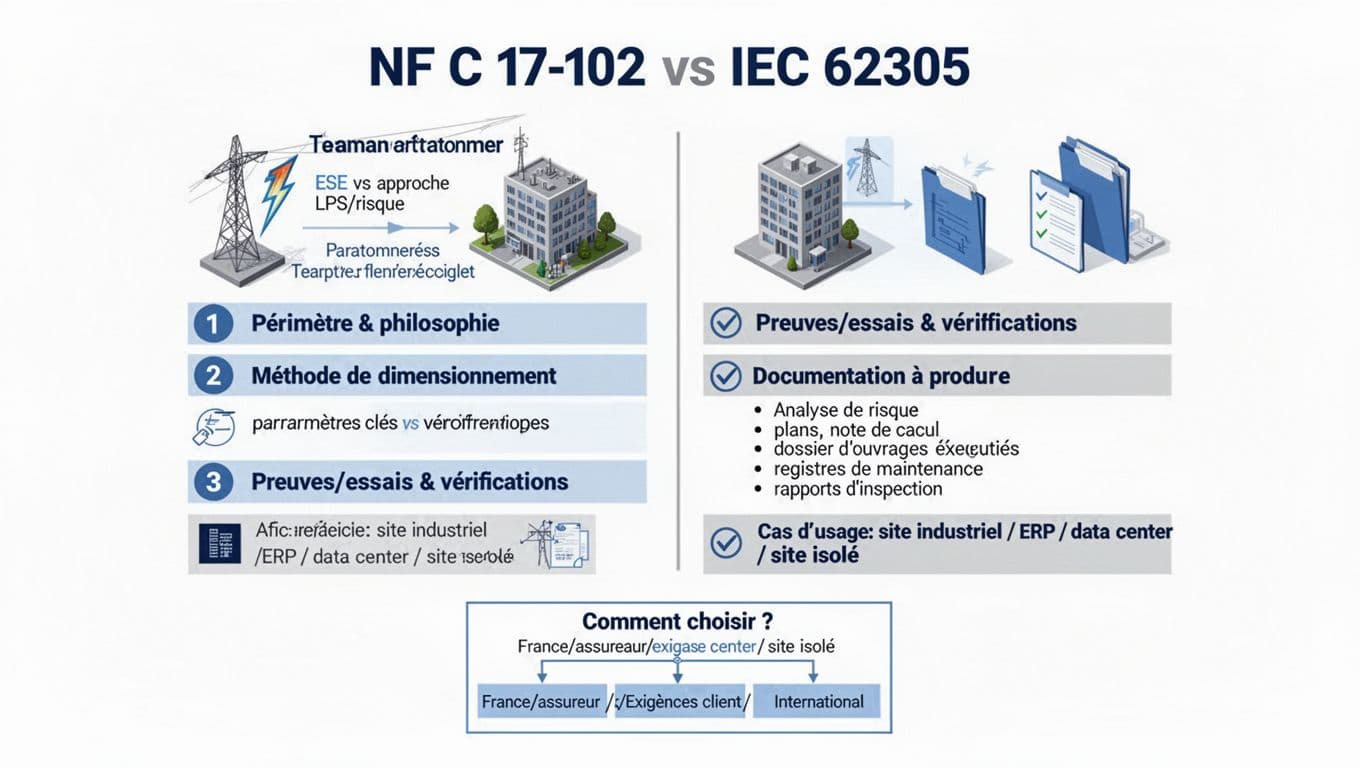
The difference can be summed up as two ways of “telling” lightning protection. NF C 17-102 mainly discusses an external protection system based on lightning rods with early streamer emission devices (ESE). It provides a design, installation, and verification method, with logic centered on the equipment.
For its part, IEC 62305 (implemented in France as NF EN 62305) treats lightning protection as a lightning protection system. It starts from the risk, then rolls out external protection (LPS, often including mesh cages), internal protection (equipotential bonding, shielding, routing), and overvoltages (SPD). Since the 2024 edition, certain concepts have evolved, notably around how to qualify risk entries and certain parameters of the analysis (according to available synthesis guides).
To frame the comparison between these international and national standards, we keep a simple rule: the first justifies a solution based on early streamer emission devices, the second justifies a level of global protection, consistent with expected consequences.
We often rely on reference resources to align design, maintenance, and QHSE teams, especially regarding compliance with mandatory standards. For example, the LPS France synthesis on the difference between NF C 17-102 and IEC 62305 helps to establish the foundations, especially when you need to explain the choice to an insurer or a client.
A good normative framework is a file that “holds” even when the person wasn’t there at the time of the project.
Before deciding, let’s look at the logical gaps, because they dictate the evidence to produce.
Here is a quick reading, useful in the pre-project phase:
| Subject | NF C 17-102 (ESE/PDA) | IEC 62305 (LPS based on risk) |
|---|---|---|
| Starting point | ESE equipment and placement rules | Risk analysis, risk calculation, protection levels (LPL) |
| Scope | External protection centered on ESE | External + internal + overvoltages |
| Expected proof | Standard compliance, controls, tests | Risk approach, layer-by-layer coherence |
The table doesn’t say “the best standard.” It says what each framework allows you to defend, with supporting evidence.
How to choose the right framework based on site, insurer, and international scope

You rarely choose “by preference.” You choose because a context demands it. First, there is geography and customer frameworks. Then, there is business criticality. Finally, there is the ability to demonstrate risk control, not just the existence of equipment.
In an ERP, you manage people, so safety and continuity requirements weigh more heavily. On an industrial site, the consequences of a shutdown or fire change the picture. In a data center, external protection without an overvoltage protection strategy is like a reinforced door with an open window.
In practice, here is the framework for your site in three common scenarios:
- Project with high international exposure: IEC 62305 (or NFPA 780) is more readily retained, because it “reads” everywhere, and because it structures the insurance narrative.
- Site in France with ESE already in place: you can stay with NF C 17-102 for external protection, provided you have a clean verification file, and address the rest (grounding, equipotential bonding, overvoltages) with a compatible framework.
- Critical site (ERP, sensitive process, data center): IEC 62305 is preferred to drive risk analysis and internal protection, even if an ESE solution is integrated if the specifications allow it.
On critical sites, integrating storm detectors is a way to improve overall protection.
Here, one point is often underestimated: IEC 62305 is not just a “calculation standard.” It is a justification method. The risk note, assumptions, and protection level choices become “insurance” evidence.
To follow recent developments, you can also rely on the LPS France guide on changes in IEC 62305:2024 (NSG, TWS), useful when you need to update a risk analysis or explain a difference between versions.
In parallel, when you need public access to NF C 17-102 to review a requirement (while waiting for the official AFNOR version), some use the PDF distributed by technical sites, for example the PDF of NF C 17-102 (2011) in English. However, one maintains discipline: you cite the exact version and trace the source, because the audit forgives no approximation.
What to document for audits, inspections and insurers (and how to avoid the “incomplete” file)
You can install a perfect system and lose the argument due to missing documents. Conversely, a clear file can avoid endless discussion, especially when maintenance changes hands. The goal is a continuous thread between design, execution, and verification.
Documentation is generally structured in 4 blocks.
1) Justification of choice and protection level
For an IEC 62305 approach, keep the risk analysis (assumptions, input data, reduction objectives). Also keep the protection level decision and trade-offs (for example, why that LPL). For NF C 17-102, document the logic of ESE placement, the protected area, and site constraints.
2) Design file and plans
Archive placement plans, descent routing, grounding points, and equipotential bonding connections. Include surge arrester coordination when they exist, with coherence of Type 1, Type 2, Type 3 surge arresters according to architecture.
3) Product evidence and compliance
Keep technical datasheets, test reports, certificates compliant with UNE-EN IEC 62561, and component references. For durable connections such as exothermic welding in grounding, UNE-EN IEC 62561 ensures quality and electromagnetic compatibility of internal protection. To clarify certain debates (ESE vs conventional), a substantive resource like the article accessible via ResearchGate on ESE vs conventional systems can serve, at least to frame internal discussion. However, avoid making it a substitute for the standard or specification.
4) Verification, maintenance, and field traceability
Establish a simple register: inspection dates, ground measurements, continuity, state of connections, dated photos, non-conformities, and corrective actions. One point helps a lot: link each finding to a location, a responsible party, and a closure date.
The day the insurer asks “prove maintenance,” you don’t look for emails, you pull out a register.
This is where a platform like LPS Manager takes full meaning for managing the lightning protection system. You centralize sites, keep reports, track verifications, and avoid scattered files. To align teams, you also rely on LPS France content, for example lightning protection standards in France and worldwide, practical when a multi-site group juggles between country requirements, clients, and insurers.
Conclusion: deciding also means preparing the proof
Choosing between NF C 17-102 and IEC 62305 is not a school rivalry. You seek the framework that fits the site, stakes, and how you will demonstrate complete lightning safety. In many projects, you gain peace of mind by combining well-defined external protection with IEC 62305 logic for risk, internal protection, and overvoltages.
At the next audit, you want a file that reads quickly, with clear assumptions and traced maintenance that provides reliable preventive protection. If you had to keep one simple rule, it’s this: a lightning protection system is worth as much for its installation of protection systems as for the evidence you can produce and retrieve, years later.
