



Managing the maintenance of a lightning protection system on a single building is already a matter of rigor. So, when you have ten, twenty, or one hundred sites, the challenge of multi-site maintenance means that the question is no longer "will we manage?", but "how do we preserve operational efficiency?".
A multi-site maintenance plan , a true facility maintenance plan for LPS (Local Public Services), is a simple yet demanding mix: a common framework, clear priorities, and a realistic, long-term schedule. In March 2026, with enhanced QHSE (Quality, Health, Safety, and Environment) requirements and sites often outsourced, time is saved when everyone speaks the same language.
This article presents a practical method, suitable for maintenance managers, operators, facility managers and QHSE managers, with a logic of calendar, priorities and monitoring via CMMS.
Build a common foundation for each site before discussing the schedule
Before setting a single date, we must agree on "what we maintain". In the LPS (Lightning Protection System), we generally talk about lightning rods (including ESE depending on the case), conductors, equipotential bonding, grounding, surge arresters, and associated control points.
The pitfall in multi-location facilities is the heterogeneous asset inventory. One site might call a piece of equipment "TGBT surge protector," another "SPD cabinet," and a third might not even have a reference. As a result, planning is done blindly. The solution is to impose standardized protocols with a single, identical reference system.
To establish the basics of an inspection and what is expected according to compliance standards, one can rely on a clear guide such as the complete LPS inspection method proposed by LPS France, and then apply the same logic to all sites.
Here are the elements that are systematically collected, site by site, within the framework of structured asset management, so that planning becomes "mechanical" rather than political:
- LPS perimeter (buildings, zones, extensions, roofs, antennas, shade structures).
- List of assets and identification (unique ID, photos, location).
- History (last check, non-conformities, pending actions).
- Access constraints (schedules, authorizations, co-activities, permits).
- Documents (reports, plans, diagrams, studies, supporting documents).
At this stage, simple Standard Operating Procedures are also established: an asset without an owner is an asset without maintenance. Therefore, a site manager (site supervisor, local maintenance, service provider) is assigned, and the approval processes are locked down.
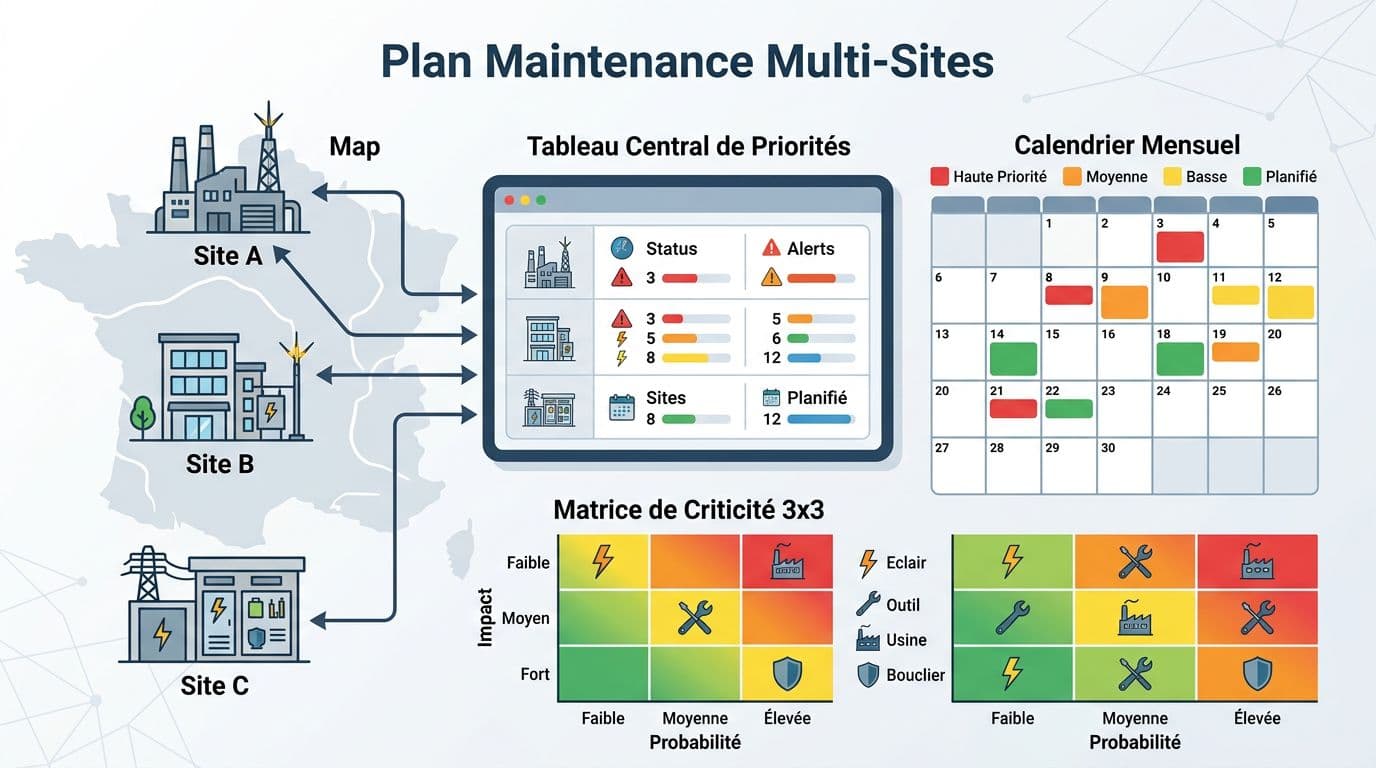
Once this foundation is laid thanks to these standardized protocols, the schedule is no longer a "wish", it becomes the logical consequence of a reliable reference for multi-site maintenance.
Define P1 to P4 priorities that are understandable by maintenance and QHSE
In a multi-site maintenance context with an LPS plan, the priority isn't "what's loudest." It's a coherent, repeatable, and audit-defensible decision, at the heart of effective maintenance governance. We need a simple system, P1 to P4 for example, based on two axes that everyone understands: impact (safety, downtime, compliance) and probability (exposure, status, history). This framework aims specifically at downtime reduction by making trade-offs explicit.
We can draw inspiration from portfolio prioritization methods, because they require making trade-offs explicit, as in this resource on project prioritization and decision criteria . The idea is not to make things complicated, but to make the choices clear.
We then formalize a short grid, usable in weekly meetings, and compatible with CMMS:
| Priority | When we use it | Examples of LPS (common) | Target time |
|---|---|---|---|
| P1 | Reactive maintenance for immediate danger, major non-conformity, high risk | Broken earth connection, faulty surge protector, cut conductor | 24 to 72 hours |
| P2 | Significant risk, proven deterioration | Internal off-target ground measurement, degraded mounting, advanced corrosion | 7 to 30 days |
| P3 | Preventive maintenance to maintain compliance | Periodic verification, tightening, continuity checks | Current month to quarter |
| P4 | Opportunity, improvement, standardization | Tracking update, addition of test points, stock standardization | Quarter to semester |
If we hesitate between two priorities, we decide with one question: "If it breaks down tomorrow, who takes the risk, and what is the concrete impact on the business?"
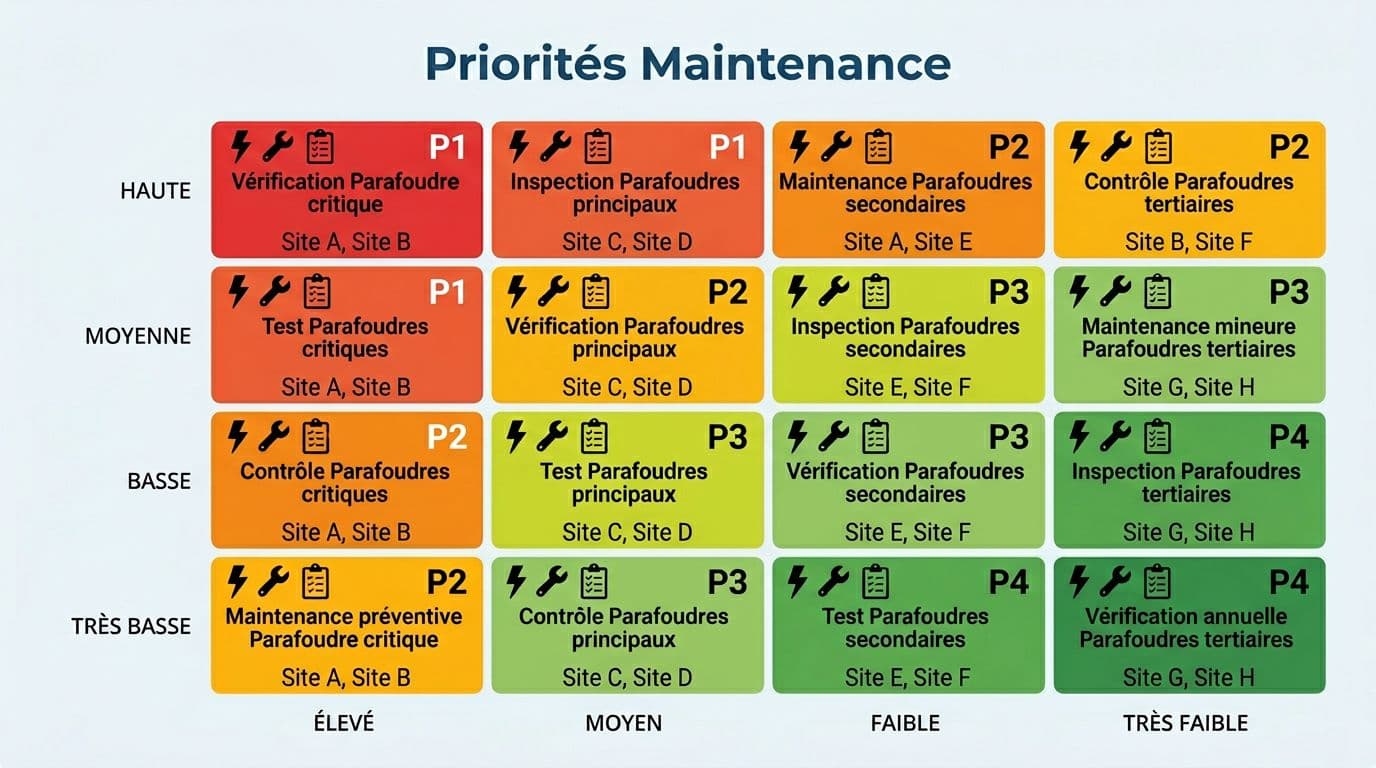
This prioritization becomes our "common language". Only then do we plan, because we know what to postpone, and especially what never to postpone.
Build a sustainable multi-site schedule for multi-site maintenance, and then implement it in a CMMS software
A multi-site LPS schedule is like a flight plan. You can draw it up very neatly on a spreadsheet, but what matters is the execution, the feedback from the field, and the continuous updating.
To build a robust maintenance scheduling calendar, three categories of work are combined:
- mandatory or expected preventive maintenance (according to your internal guidelines and applicable standards),
- the corrections resulting from the discrepancies (P1 and P2 first),
- improvement actions (P3 and P4, when capacity allows).
We also gain in realism by taking the season and workload into account. Some sites have downtime windows, others don't. Several teams share the same contractors, which promotes vendor consolidation. Roof work requires weather conditions, access, permits, and sometimes a cherry picker. Planning means making informed decisions with proper resource allocation.
Regarding planning optimization, academic approaches highlight a useful point: dependencies and resources must be managed, not just dates. For further reading, see this paper on optimizing maintenance schedules (useful for structuring your thinking, even if you remain pragmatic in your day-to-day work).
Here is a simple sequence that works well in multi-site environments:
- We schedule non-negotiable appointments (preventive maintenance inspections, audits, customer deadlines).
- We are blocking a monthly capacity for the P1/P2 patch (otherwise, everything explodes).
- We group them by geographical areas to reduce travel and downtime.
- We spread out the P3/P4 tasks over the "off" weeks.
- We validate the schedule with operation, then we publish a fixed version (and a replanning rule).
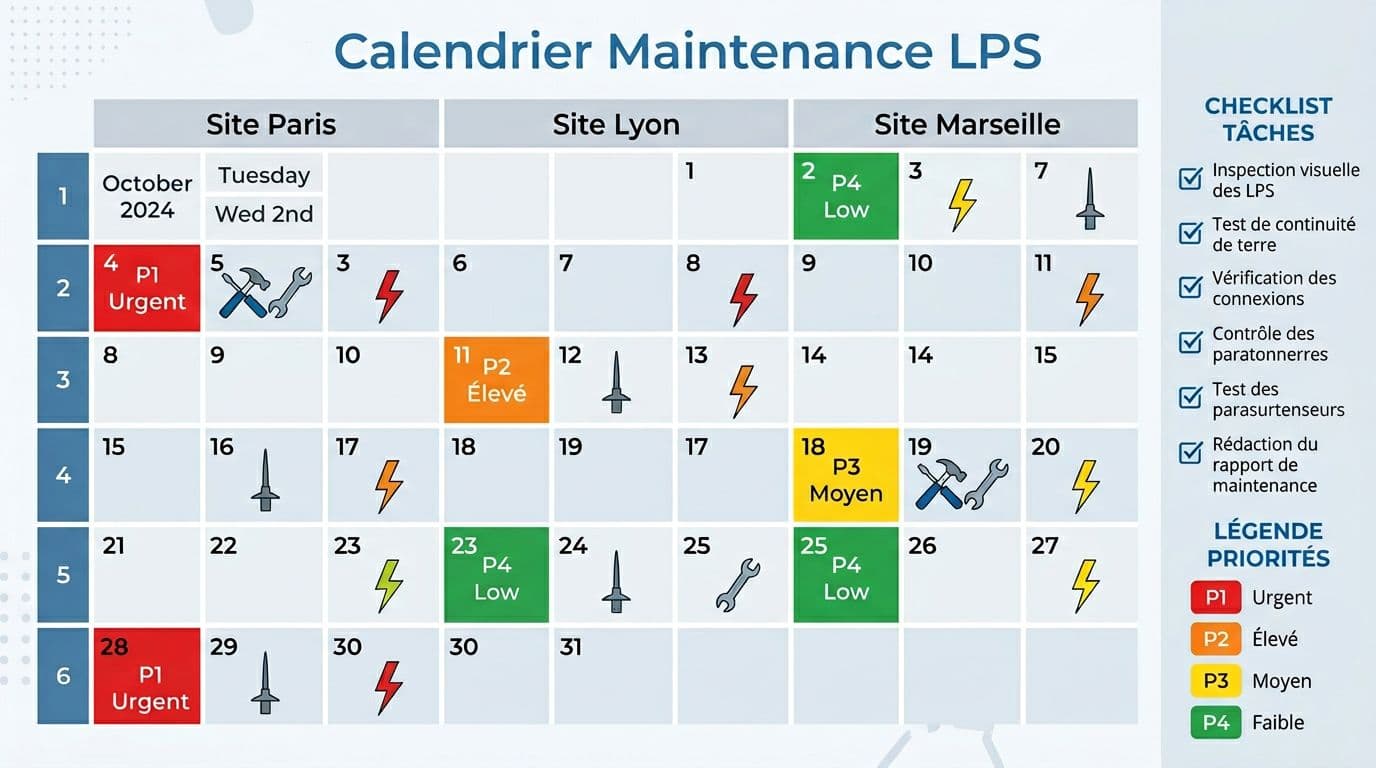
Next, we avoid "ghost scheduling" by managing it within a CMMS software, with work orders, statuses, attachments, and on-site verification via mobile maintenance. Regarding multi-site challenges, feedback from experience, such as these best practices for multi-site management, helps to frame standardization, even if it's adapted to lightning strikes.
In our case, a dedicated platform like LPS Manager serves as the backbone for the facility management software: site monitoring, centralized document management, shareable reports, and also weather and lightning alerts with real-time data, depending on the features activated. For concrete feedback and demonstrations, you can follow the LPS France YouTube channel , which is useful for aligning internal teams and service providers on the same methodology. This approach opens the door to predictive maintenance via IoT sensors or a digital twin, with KPI tracking to measure equipment uptime.
Ultimately, a useful schedule is not "full," it is maintained through a solid facility maintenance plan.
multi-site maintenance plan can be identified by two simple signs: P1s are completed promptly, and preventive maintenance inspections are kept up to date. By implementing a common repository, prioritizing P1 to P4, and then using a maintenance scheduling calendar managed by facility management software and CMMS software with centralized work orders, you regain control without adding to your daily workload. This boosts operational efficiency, reduces downtime, and improves cost control across your multi-location facilities. The next logical step is to start with a pilot site for scaling maintenance, then expand in phases with centralized management, maintaining the same rules. And at your facility, which priority comes up most often, P1 or P2?